
Free Online Pomodoro Timer for Students: How It Works and Why You Need One
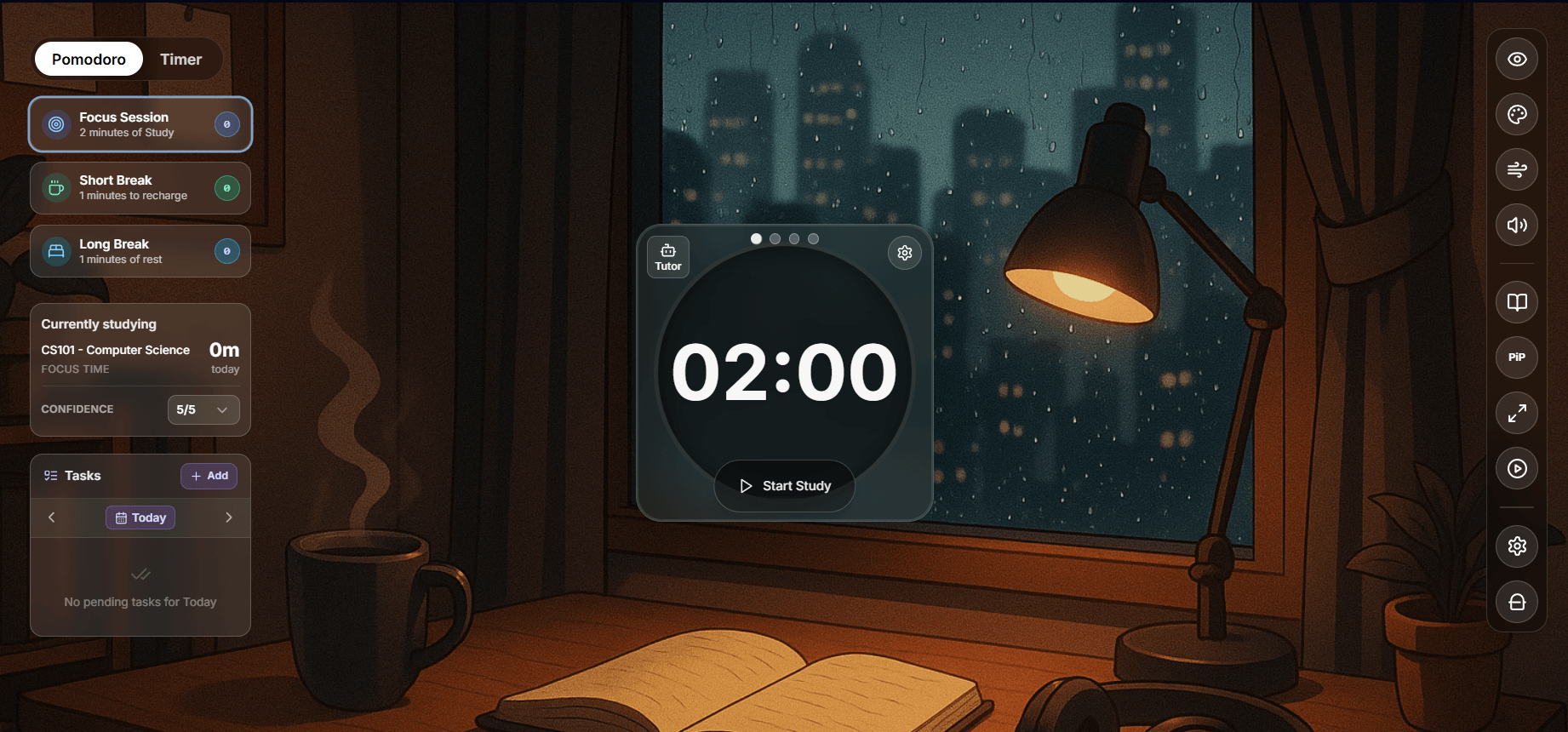
Learn how to use a free Pomodoro timer for students, choose realistic focus and break intervals, and build a study routine that supports consistent progress.
Most students don't have a focus problem. They have a starting problem.
Sitting down to study three chapters of Organic Chemistry or two units of Calculus feels like committing to something enormous. So you delay. You check your phone, reorganize your notes, get water, check your phone again. Before you know it, an hour is gone and the books are still closed.
A Pomodoro timer fixes this in a way that willpower alone doesn't. Not because it's magic, but because it makes the ask smaller. Instead of "study for three hours," the ask becomes "study for 25 minutes." That's it. Just 25 minutes, then a break. Almost anyone can agree to that.
This guide covers how the technique works, what the science actually says about it, how to pick a free online Pomodoro timer, and how AcademyNC's shared Pomodoro timer adds something that solo timers can't.
What Is the Pomodoro Technique?
Francesco Cirillo developed the Pomodoro Technique in the late 1980s as a university student struggling with focus and a heavy workload. He used a tomato-shaped kitchen timer (pomodoro means tomato in Italian) to break his study sessions into short, concentrated intervals.
The basic structure is simple:
- Pick one task to work on
- Set a timer for 25 minutes and work on only that task
- When the timer rings, take a 5-minute break
- After four cycles, take a longer break of 20 to 30 minutes
That's the whole system. The reason it works comes down to how the brain handles sustained attention, which is less reliable than most students assume.
Why 25 Minutes? The Science Behind It
Research on sustained attention consistently shows that performance starts degrading within 20 to 45 minutes of focused work without breaks. The brain doesn't maintain peak concentration in a straight line. It fluctuates, and without a deliberate break, it gradually habituates to the task, which is basically a fancy way of saying it stops fully engaging with what's in front of it.
A University of Illinois study found that brief diversions from a task significantly improve the ability to focus on it for extended periods. The researchers found that without breaks, attention "habituation" occurs where the brain essentially stops noticing what it is supposed to focus on.
The 5-minute break isn't wasted time either. During a break, the brain shifts from focused processing to what researchers call diffuse mode, where it processes and consolidates what it just learned. This is part of why you sometimes figure out a problem in the shower rather than staring at it for another hour.
There's also the Zeigarnik effect, named after psychologist Bluma Zeigarnik, which shows that people remember interrupted tasks better than completed ones. When the Pomodoro timer rings mid-concept, your brain continues working on it during the break. The break keeps the material "active" in working memory through the transition.
The upshot: the 25-minute structure isn't arbitrary. It aligns reasonably well with how long most people can maintain genuine focus before quality starts dropping.
What to Look for in a Free Online Pomodoro Timer
There are dozens of free Pomodoro timers available. Most do the basics. Here's what separates the useful ones from the forgettable ones:
Simplicity. A timer should start immediately. If you need to create an account, configure settings for ten minutes, and navigate three screens before the countdown begins, it's already introduced friction that the technique is supposed to remove.
Customizable intervals. The classic 25/5 cycle works well for most tasks. But for deep reading or complex problem-solving, some students do better with 50-minute sessions and 10-minute breaks. A good timer lets you adjust this without a paid subscription.
Break reminders. One thing students get wrong consistently is skipping breaks. They're "in the zone," so they ignore the timer and keep going. This feels productive and usually isn't. A timer that alerts you clearly at the end of each session makes it harder to skip the break.
No distractions built in. Some timers have social feeds, leaderboards, chat, music players, and about twelve other things on the screen. That defeats the purpose. The timer should occupy a corner of your screen while your study material takes up the rest.
Shared timer option. This matters more than most people realize, which is worth its own section below.
Why a Shared Pomodoro Timer Works Better for Group Study
A regular Pomodoro timer works fine when you're studying alone. But if you're studying with a partner or a group, whether in person or online, individual timers immediately create a coordination problem.
One person finishes their Pomodoro. The other has six minutes left. Someone takes a break early. Someone else doesn't take a break at all. The structure collapses.
A shared Pomodoro timer keeps everyone on the same countdown. When the session starts, every device shows the same number. When time is up, it's up for everyone simultaneously. This creates a shared rhythm that's more powerful than each person managing their own clock.
There's also the body-doubling effect: the psychological phenomenon where working alongside other people, even silently and even virtually, increases focus and reduces procrastination. Knowing that other people are actively in the same Pomodoro block as you makes it harder to quietly drift.
AcademyNC has a shared Pomodoro timer built into its virtual study rooms for exactly this reason. You and your study partners start the same timer, study in sync, break together, and start the next block together. It replicates the accountability of studying in a library with other people, without requiring everyone to be in the same city.
How to Use a Pomodoro Timer Effectively
The technique is simple but there are a few things students consistently get wrong.
Set a specific task before starting the timer. Not "study Biology." Something like "finish Chapter 12 and solve 15 practice questions from it." Vague targets produce vague sessions. The more specific the task, the more useful the 25 minutes.
Close everything unrelated. Tabs, notifications, the group chat. A Pomodoro session means that one task and nothing else. Checking a notification mid-session resets your focus in a way that costs more time than the notification itself.
Actually take the breaks. This is the one students skip most often. The break is not optional. It's what makes the next Pomodoro possible. Walk around, get water, look away from the screen. Do not scroll social media during break time. That's stimulation, not rest, and it doesn't let your brain recover.
Track your sessions. After a week of Pomodoros, you'll have a rough count of how many focused sessions you actually completed. Most students are surprised by how low this number is relative to how many hours they think they studied. It's a useful reality check.
Adjust the intervals for the subject. Creative subjects and heavy reading often work better with longer blocks, like 45 or 50 minutes. Maths practice, flashcard review, and short answer questions fit well into 25-minute blocks. Don't force every subject into the same interval.
Pomodoro Variations Worth Knowing
The classic 25/5 is the starting point, not the only option. A few variations that work well for students:
50/10: 50 minutes of focused work, 10-minute break. Better for subjects that need deep immersion, like reading-heavy subjects, long derivations, or essay writing. The longer session allows you to get properly into a topic before the break.
45/15: A middle ground. Works well for subjects that need sustained focus but where 50 minutes feels like too long to maintain quality concentration.
90/20: Used by some serious exam aspirants during peak preparation. 90-minute blocks aligned with the brain's natural ultradian rhythm of alertness. Demanding, but effective for students who have already built a strong focus habit and need to extend it.
Start with 25/5 if you're new to the technique. Move to longer intervals once 25 minutes consistently feels short rather than challenging.
Common Mistakes With the Pomodoro Technique
Counting breaks as part of the study session. A 25-minute Pomodoro plus a 5-minute break is 25 minutes of study, not 30. If you're planning to study for 5 hours, that means 12 Pomodoros of actual focused work.
Using the break to check messages. This is the single most common way students undermine the technique. The break is cognitive rest. Checking Instagram or replying to texts is a different kind of cognitive activity. It doesn't let the brain recover, which means the next Pomodoro starts at reduced capacity.
Abandoning the timer when you feel focused. Some students stop using the timer the moment they feel in flow. This feels smart but removes the structured break. Eventually the extended session runs into fatigue and the rest of the day suffers. The break after a good block is just as important as the break after a difficult one.
Starting too many Pomodoros without finishing them. If you start a session and abandon it after 8 minutes, that doesn't count. The technique works through the completion of blocks. Partial sessions don't produce the same psychological effect of having finished a unit of work.
Doing too many Pomodoros in one day too quickly. If you've been studying 4 to 5 Pomodoros a day and try to jump to 12 in a single week, you'll burn out. Add two or three extra sessions per week, not ten overnight.
How to Use AcademyNC's Shared Pomodoro Timer
AcademyNC's shared Pomodoro timer is free and built into the study rooms on the platform. Here's how it works in practice:
You create or join a study room. Everyone in the room sees the same timer. One person starts it, and the countdown runs simultaneously on every device. When the session ends, everyone gets the break notification at the same time. The next block starts when the group is ready.
For partner matching, AcademyNC also connects you with students who have similar schedules and goals, so you can find someone to run Pomodoros with consistently rather than studying alone with a solo timer every time.
If you're a self-study student preparing for a competitive exam or just trying to hold a consistent routine, having a shared timer with a study partner a few times a week makes a measurable difference to how many sessions you actually complete.
FAQs
Is the Pomodoro Technique actually effective for students?
Research on sustained attention supports the core idea. The 25-minute interval aligns with how long most people can maintain peak focus before quality begins to drop. It's not a guarantee of better results, but students who use it consistently report more sessions completed and less time wasted on distraction.
Can I use a Pomodoro timer for long study sessions like 8 to 10 hours?
Yes, but adjust the intervals. For very long study days, 50/10 or 45/15 cycles tend to hold up better than repeated 25/5 cycles. Also build in one or two longer breaks of 30 to 45 minutes across the day, not just 5-minute breaks between sessions.
What is a shared Pomodoro timer?
A shared Pomodoro timer runs the same countdown on multiple devices simultaneously, so a group of students can study in sync. When the timer rings, it rings for everyone at the same moment. AcademyNC has a free shared Pomodoro timer built into its virtual study rooms.
Does the Pomodoro Technique work for all subjects?
It works for most subjects but the ideal interval varies. Problem-solving and flashcard review fit well in 25-minute blocks. Heavy reading and essay writing often benefit from longer 45 to 50-minute sessions. Experiment with intervals to find what works for each subject.
How many Pomodoros should I do per day?
For a full study day, 8 to 12 Pomodoros (4 to 6 hours of focused work) is realistic. Beyond 12, the quality of sessions tends to drop even if the timer keeps running. If you're new to the technique, start with 4 to 6 per day and build from there.
Should I use the Pomodoro Technique for every study session?
It's most useful for sessions where you know you're prone to distraction or procrastination. For sessions where you're deeply engaged and the work is flowing, you don't necessarily need to stop for a break every 25 minutes. Use the technique as a tool, not a rigid rule.
What's the best free Pomodoro timer for students in 2026?
For solo study, Pomofocus and Pomodorotimertool.com are clean and free. For group study with a shared timer and study partner matching, AcademyNC is the most complete option because the timer is built into a platform designed specifically for students studying together.
Conclusion
A Pomodoro timer works because it makes starting easy and makes stopping intentional. Both of those things are harder to manage without a structure around them.
If you've been struggling with long, unfocused study sessions where hours pass without much getting done, the 25-minute block is worth trying seriously for a week. Not just running a timer, but doing it properly: one specific task, no distractions, and actual breaks between sessions.
For students who study with partners or groups, a shared timer on AcademyNC adds the accountability layer that makes the technique significantly more consistent. You can try it free at shared Pomodoro timer.