
How to Answer Source-Based Questions in Exams
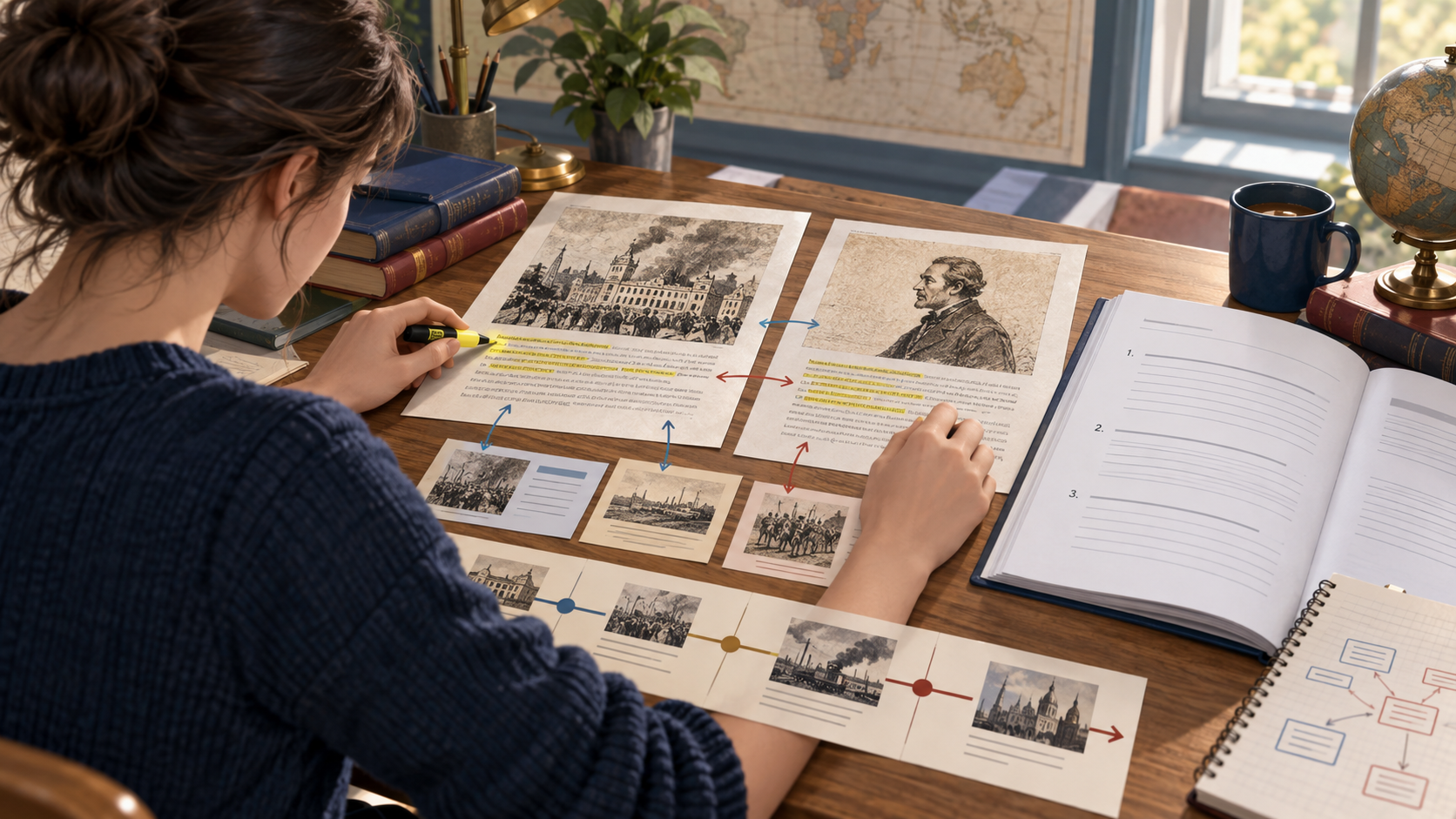
Learn a clear method for reading sources, using evidence, adding context, and building answers that respond to the exact question.
Source-based questions can feel confusing because the answer is not sitting in your notes in one neat paragraph. You have to read a source, work out what it suggests, use details as evidence, and connect that evidence to the question. Some questions also ask you to compare sources, judge reliability, or explain how useful a source is.
The good news is that source questions follow repeatable moves. You do not need to guess what the examiner wants. Read the task, understand what the source says, add the right context, and make a judgement that answers the question. Practising this sequence is more useful than memorising a single model paragraph.
What source-based questions test
A source may be a written extract, photograph, poster, speech, graph, map, interview, diary, or short data set. The question may test comprehension, inference, comparison, provenance, reliability, usefulness, or a judgement about a claim.
The source is evidence, not the entire answer. You need to use what is in front of you, but you may also need knowledge from the course. Your job is to explain how the evidence supports, challenges, or limits an answer to the exact question.
Read the question before the source
Start with the question and underline the key task. Look for the topic, time period, people or place involved, and command word. A question asking what a source shows is different from one asking how useful the source is.
If you read the source first without knowing the task, you may highlight everything. Instead, make a small target. Ask what information would help me answer this question? This keeps your reading selective and stops you spending time on interesting details that do not earn marks.
Identify the source type and purpose
Notice who made the source, when it was made, where it appeared, and what kind of source it is. A private diary, government speech, newspaper cartoon, textbook summary, and interview may show different viewpoints because they were created for different reasons.
Purpose does not automatically make a source false. It tells you what the creator wanted to do and what you should check. A campaign poster may exaggerate to persuade. A private letter may reveal feelings but only one person’s view. Use the purpose to judge the evidence, not to dismiss it in one sentence.
Underline useful evidence
Choose short details that directly answer the question. Quote a phrase or describe a feature of an image, graph, or map. Then explain what the detail shows. Do not drop a quote into the paragraph and move on.
A strong explanation connects the evidence to the question. You can use a simple pattern: the source says or shows this detail; this suggests a particular idea; that matters because it answers the question in this way. The explanation is often where the marks are earned.
Make an inference
An inference is a meaning you work out from the evidence. It goes beyond copying the source. If a source describes empty shops and long queues, you might infer that people were facing shortages. Make sure the inference is supported by the detail you selected.
Avoid inventing information that the source cannot support. Ask yourself, what exactly made me think this? If you cannot point to a word, image feature, number, or pattern, your inference may be a guess rather than analysis.
Add your own context
Context is the relevant knowledge you bring from the course. It can explain why the source was created, confirm or challenge a claim, or show what happened before and after the source. Use only context that helps answer the question.
Do not attach a random fact because you remember it. Explain the link. For example, if a source claims that a policy was popular, use a known event, group response, or result to test that claim. Context should act like a check on the source, not a separate mini-essay.
Compare sources carefully
When a question asks you to compare sources, start with one clear similarity or difference. Use evidence from both sources, then explain why they might agree or disagree. Comparison means more than writing about source A and then source B in separate paragraphs.
Use paired language such as both sources suggest, while source A presents, source B claims, or the sources differ because. Check whether the sources discuss the same time, group, event, or question. A difference may come from purpose, audience, timing, or access to information.
Evaluate reliability and usefulness
Reliability asks how much you can trust a source for a particular claim. Use provenance, content, and context together. A source may be reliable for showing what the creator believed but less reliable for proving what everyone believed.
Usefulness is also linked to the question. A source can be useful even if it is biased because the bias reveals the creator’s aim or the attitude of a group. A balanced answer explains both what the source helps you understand and what it cannot tell you.
Match your answer to the command word
If the question says describe, stay close to what the source shows. If it says explain, add reasons and links. If it says compare, keep both sources in the same discussion. If it says evaluate or how useful, weigh strengths and limits before reaching a judgement.
Your command-word notes from revision are useful here, but do not force the same structure onto every question. Let the marks and the wording guide the amount of detail. Answer the task you were given, not a different task that you practised yesterday.
Build a paragraph structure
A reliable paragraph can use five moves: make a point, use a source detail, explain the inference, add relevant context, and link back to the question. You will not always need every move in every short question, but this pattern helps you develop longer answers.
For a judgement question, begin with the strongest reason, test it against another source or piece of context, and then decide which evidence matters most. Make the decision visible. Do not leave the reader to guess your conclusion from a list of facts.
Use a source pack efficiently
Before writing, scan all sources and mark one useful detail for each. Make a quick grid with columns for source, main message, evidence, purpose, and useful context. This takes less time than searching through the pack every time you write a sentence.
Keep the question beside your notes. A source may be useful for one task and irrelevant to another. Do not force every source into the answer just to prove that you saw it.
Practise with timed questions
Start with an untimed question so you can learn the moves. Then use a study timer and set a realistic limit. Plan for a minute or two, write the answer, and leave a final moment to check that you used the sources and answered the command word.
Change the question type across sessions. Practise inference, comparison, reliability, usefulness, and judgement. A short AI practice quiz can help you generate prompts, but you should still use the course sources and mark scheme that match your exam.
Review answers with the mark scheme
Read the mark scheme after attempting the answer, not before. Mark where you used evidence, explained it, added context, compared sources, or reached a judgement. Then write one repair task for the next session.
Your repair task should be small. You might practise linking evidence to an inference, write two comparison sentences, or add a relevant context sentence to an old answer. Use the study time tracker to see whether repeated practice is improving the same skill.
Common source-question mistakes
Do not copy long quotations without explaining them. Do not describe a source without answering the question. Do not call a source biased and stop there. Do not add a fact that has no link. Do not write about one source when the task asks for two.
Also avoid treating a source as either completely true or completely false. Historical and social evidence is usually more useful when you explain its limits and its purpose.
Frequently asked questions about source questions
Do I need to use every source?
Only if the question or mark scheme expects it. Use the sources that answer the task. If a source adds nothing, explain why it is less useful rather than inserting it randomly.
How much context should I add?
Add enough to explain, test, or limit the source. A short relevant fact is better than a long paragraph of unrelated knowledge. The context should help the reader understand why the source matters.
What if the source seems biased?
Explain who created it, what they wanted, and how that affects the claim. Bias can reduce usefulness for one question but make the source valuable for understanding an attitude, purpose, or audience.
Related AcademyNC tools
Use the AI practice quiz for short source prompts, the study timer for timed answer practice, and the study planner to spread different source-question skills across the week. Track your practice with the study time tracker and write down the skill you repaired after each answer.
Final thoughts
Source-based questions reward careful reading and clear explanation. Read the question first, choose evidence that matters, make a supported inference, add relevant context, and judge the source for the task you were given.
With practice, the source stops feeling like a surprise. It becomes a set of clues you can use to build an answer.




