
How to Make a Formula Sheet for Maths and Science Exams
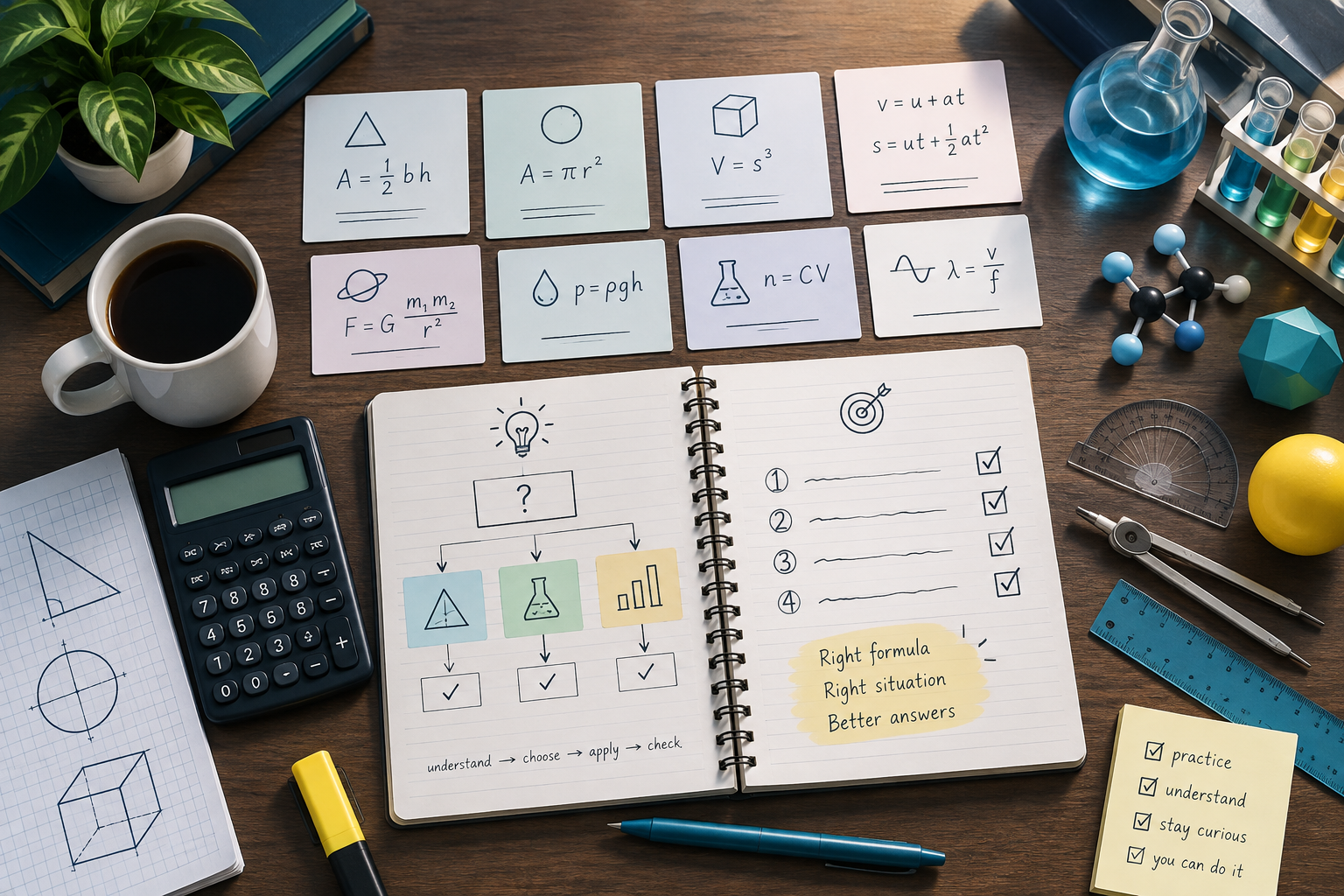
Build a useful formula sheet that explains what each formula means, when to use it, and how to check your answer in an exam.
A formula sheet is more than a page full of equations. A useful sheet helps you recognise a problem, choose the right formula, understand the symbols, and check whether your answer makes sense. Making the sheet can also become revision because you must decide what belongs on it and how the ideas connect.
This guide is for maths and science students who want a simple formula revision system. You can use it whether your exam gives you an equation sheet or expects you to remember the formulas yourself.
Why make your own formula sheet
A textbook may show formulas in many chapters, while an official exam sheet may list them without much explanation. Making your own version brings the information together. You can add the details that help you, such as units, conditions, a diagram, or a reminder about common mistakes.
The sheet is not meant to replace practice. If you only read it, the formulas may look familiar but disappear when a question changes. Use it as a map for problem solving and as a prompt for recall.
Start with the exam specification
Begin with the syllabus, specification, teacher checklist, or official formula list for your course. This prevents you filling the page with interesting equations that will not be tested. Check the exact version for your exam board or class because formulas and symbols can differ.
Mark each formula as must remember, useful to recognise, or provided in the exam. If you are not sure, ask your teacher or check the official guidance. Do not assume a formula is provided just because another class uses the same paper.
Group formulas by idea
A random list is hard to use. Group formulas by the problem they help solve. Maths might include area, volume, speed, algebra, probability, and trigonometry. Physics might include motion, forces, energy, electricity, waves, and thermal calculations. Chemistry might include moles, concentration, gas volumes, and energy changes.
Keep connected formulas together. If one equation can be rearranged into another, show that relationship. If two formulas look similar but apply in different situations, place a short warning between them. Grouping reduces the time you spend searching during practice.
Write what each symbol means
Never write an equation without explaining the letters. For every formula, add a short line for each symbol and its unit. A student may know that density equals mass divided by volume but still lose marks by mixing grams with kilograms or centimetres with metres.
Use plain language. Write mass in kilograms, volume in cubic metres, and density in kilograms per cubic metre. If the subject uses a special symbol, draw it clearly and keep the notation consistent with your lessons.
Add units and conditions
Units are part of the method, not decoration. Add the standard unit beside each quantity and note any conversion you often forget. For example, remind yourself to convert minutes to seconds or centimetres to metres before using an equation.
Also write conditions. A formula may apply only to a certain shape, a constant temperature, a closed system, or a particular type of motion. A short note such as only for uniform acceleration can prevent you choosing the equation because the letters look familiar.
Show when to use each formula
The most useful line on a formula sheet may be a question: what kind of problem is this? Next to an equation, write a clue such as find the final speed when time and acceleration are known or compare energy transferred with power and time.
Do not write a full worked solution. Write enough to help you recognise the situation. You can also add a small list of quantities the question gives you. This turns the sheet into a decision guide.
Include one small example
A tiny example shows how the formula works. Choose simple numbers and label each step. Keep the example short enough to scan. For a science formula, include the units and final answer. For a maths identity, include one line that shows how it changes a problem.
The example is not there to memorise the numbers. It is there to remind you about the order, substitution, and format. After making the sheet, cover the example and try to recreate it from the formula.
Separate must-know and provided formulas
Use two sections if your exam gives some formulas but expects others from memory. This avoids spending all your time memorising something that will be printed on the paper. Provided formulas still need to be understood because you must know when and how to use them.
A must-know formula can have a recall prompt. Write the formula name on one side of a card or blank space and produce the equation before checking. If you cannot remember it, practise it in a question rather than staring at the line.
Test the sheet without looking
Close the sheet and write the formulas you remember. Then check the symbols, powers, signs, and units. A formula that is almost right may still give a wrong answer. Repeat this short recall after a gap.
You can also ask yourself when would I use this, what information does it need, and what changes if one value doubles? These questions test understanding, not only copying.
Use the sheet for problem practice
The real test is a new question. Read the question first and list the quantities it gives you. Decide what the question wants. Only then look at the sheet if needed. Point to the group that fits and explain why you chose the formula.
After solving, check the size and unit of the answer. If the result looks impossible, check conversion, rearrangement, and substitution. Keep questions that exposed confusion so you can return to the exact problem type.
Update it from your mistakes
A formula sheet should change as you learn. Add a warning when you choose the wrong equation, forget a square, use the wrong unit, or rearrange incorrectly. Put the warning beside the formula instead of writing a long story.
If the page becomes crowded, make a cleaner version. The new version should keep the useful reminders and remove information you no longer need. This is a good way to turn mistakes into a simple revision resource.
Make the page easy to scan
Use clear headings, spacing, boxes, arrows, and a consistent layout. Put similar formulas in the same position each time. Do not use so many colours that every line looks important. One colour for formulas and one for warnings is often enough.
Write or print it large enough to read quickly. If the sheet is digital, keep a copy you can view without searching through many folders. Use a study planner to schedule a short formula recall session before problem practice.
Common formula sheet mistakes
Do not copy a formula without the meaning of its symbols. Do not ignore units. Do not include every equation you have ever seen. Do not rely on reading the sheet instead of solving questions. Do not make the page so decorative that it hides the decision clues.
Avoid changing notation halfway through. Do not use an example that skips the step where you usually make a mistake. Most importantly, do not treat a correct-looking formula as proof that you know when to use it.
Frequently asked questions about formula sheets
Should I copy every formula from the textbook?
No. Start with the official course list and add only formulas that support your exam questions. Include a short note about meaning, units, and use instead of filling the page with duplicates.
How do I remember which formula to use?
Practise identifying the question type before opening the formula sheet. After each problem, say why the formula fits. An AI practice quiz can give you varied questions so you learn to choose, not just substitute.
Can I use a formula sheet in the exam?
That depends on your exam rules. Check the official instructions. Even when a sheet is provided, learn the meaning and application of the formulas because the paper may not tell you which one to choose.
Related AcademyNC tools
Use the study timer for short recall and problem-solving blocks. Put formula practice into the study planner, create varied questions with an AI practice quiz, and use the study time tracker to see which problem types still need work.
Final thoughts
A good formula sheet answers four questions: what does the formula mean, what do the symbols represent, when should I use it, and how can I check my answer? Build it from the course requirements, add units and conditions, then test it with real questions.
The sheet becomes most useful when it changes with your mistakes. Keep it clear, practise without it, and use it as a guide rather than a replacement for understanding.




