
How to Make a Study Checklist for Exams
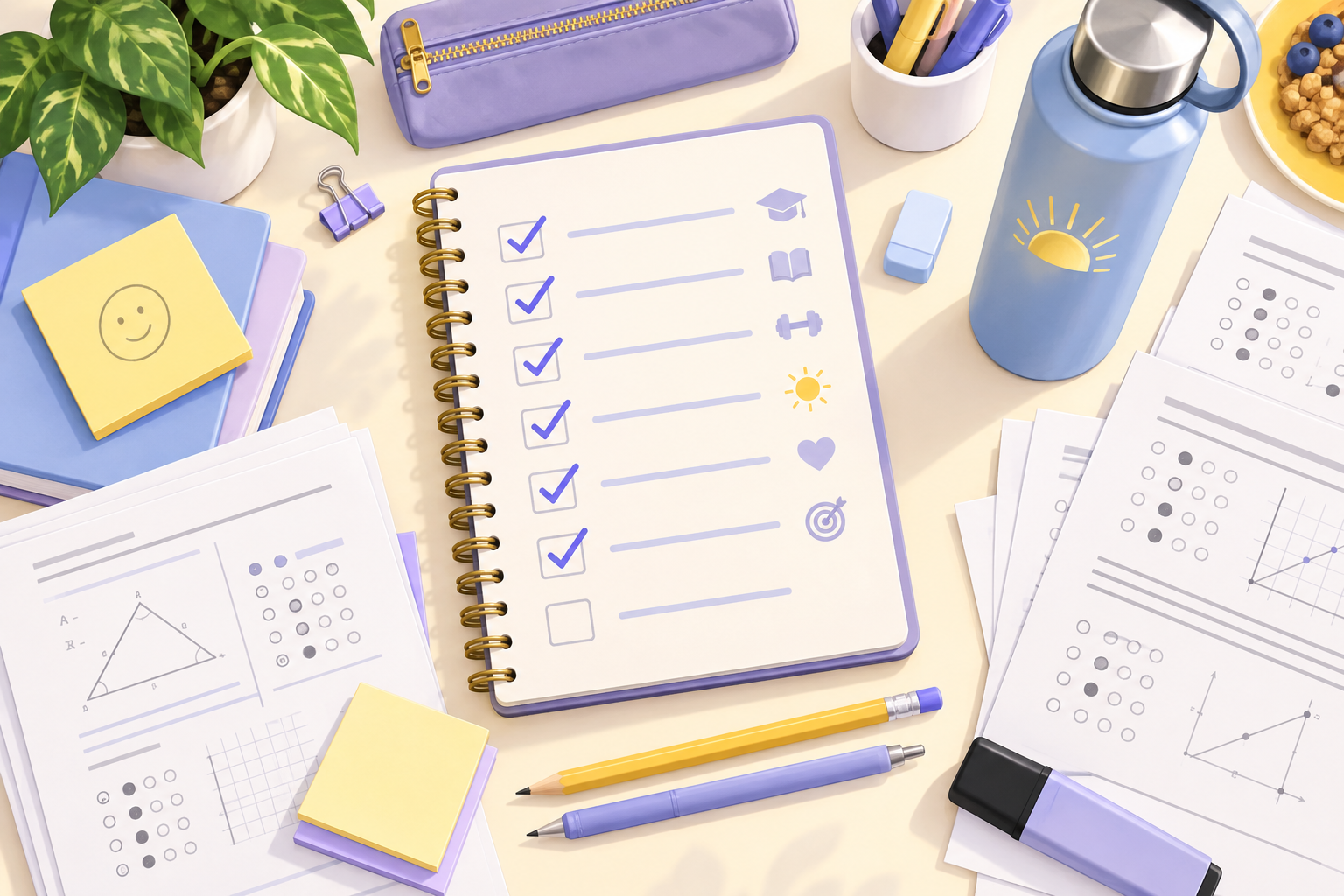
Create an exam study checklist that turns a syllabus into clear tasks, prioritises weak topics, and keeps revision practical without becoming overwhelming.
An exam checklist can make revision feel calmer, but only if it helps you decide what to do next. A long list of chapters may look serious while giving you no clear action. A useful checklist turns broad topics into small tasks, shows what matters most, and leaves space for practice and correction.
The checklist is not a promise to complete everything in one heroic weekend. It is a working map. You can use it to see the exam boundary, choose high-value gaps, schedule focused blocks, and notice progress. This guide explains how to build one that stays useful when your timetable changes.
Why an exam checklist helps
Without a list, students often revise the easiest topic because it is comfortable or spend too long choosing resources. A checklist reduces that decision load. It gives your study session a visible target and helps you restart after a break or a difficult day.
A good checklist also protects against the feeling that nothing is finished. When a task says answer ten questions and correct the mistakes, you can see the work completed. The list becomes a record of useful actions rather than a reminder of every page you have not opened.
Collect the real exam scope
Start with the syllabus, teacher guidance, assessment outline, revision sheet, and past questions. Record what can actually appear. Check whether the exam covers the whole course, selected units, particular command words, practical skills, formulas, texts, or case studies.
Add dates, question types, marks, and allowed materials if you know them. These details affect your checklist. A high-mark essay needs more practice than a small definition section, and an open response needs a different task from a multiple-choice section.
Build a master topic list
Write one line for each topic or skill. Avoid grouping everything under a large heading such as biology or mathematics. Break it into parts you can review and test. A master list might include definitions, processes, calculations, diagrams, examples, and common question forms.
Keep the list visible but not overwhelming. If a topic is large, create a second page for its subtopics. The first page should help you choose the next task. The detail page should help you study that task.
Separate knowledge from practice
Every topic needs more than one kind of work. Knowledge tasks include learning definitions, understanding a process, or recalling a formula. Practice tasks include solving questions, planning an answer, interpreting data, drawing a diagram, or explaining a method. Put both on the checklist.
A completed reading task does not automatically mean you can use the information. Add a retrieval task after it. For example, read a section, close the notes, write the key ideas from memory, and answer two questions. This makes the checklist measure learning, not just time spent.
Choose priorities with evidence
Mark topics as secure, workable, weak, or unknown. Use recent tests, homework, class feedback, and practice questions to decide. Do not rank every topic by how anxious it makes you feel. A topic that feels scary may be familiar, while a simple-looking topic may hide a gap.
Prioritise frequent or connected skills, topics where a small repair can improve several questions, and errors that repeat. Put low-value or very difficult work into a later column instead of letting it take over the entire plan. A checklist should show trade-offs honestly.
Turn each item into an action
Replace revise algebra with solve eight linear-equation questions and explain two mistakes. Replace study chapter three with recall the four key processes and draw the diagram without notes. Actions make the finish line visible and tell you how to check whether the task worked.
Use a verb at the start: define, recall, solve, compare, plan, explain, mark, correct, or review. If you cannot choose a verb, the item is still too vague. You can always make the task smaller once you begin.
Make daily checklists smaller
Choose the most important tasks for today rather than copying the entire master list into your daily page. A realistic checklist may contain two deep tasks, one short recall task, and one review task. Leave room for school and normal life.
Estimate time using your past work, not your best hope. If a task normally needs 45 minutes, do not schedule four of them into a one-hour window. Use the study planner to place the tasks and the study timer to keep each block contained.
Add practice and error review
Practice questions should appear on the checklist before the final days. Add a task such as complete a mixed set, mark it, and record three errors. The feedback is what turns practice into improvement. Without marking, you may repeat the same method and assume it is working.
Schedule a return to important errors. A mistake reviewed once can feel fixed while the idea is still fragile. Revisit it after a few days and solve a similar question without looking at the correction. This gives the checklist a memory cycle instead of a one-time tick.
Include materials and logistics
Your checklist can contain practical items too: check the exam time, prepare equipment, print or download permitted materials, charge a calculator, find the room, and pack a water bottle if allowed. These tasks take little time but reduce avoidable stress.
Separate logistics from learning so neither gets forgotten. The checklist is not only about chapters. It is a plan for arriving ready to use what you have studied.
Use a planner and timer together
The checklist says what; the planner says when; the timer protects the block. Link them. When you schedule answer five practice questions, set a start time and an expected end. If the task expands, write down why and adjust the next block instead of quietly losing your break.
A study time tracker can show whether your checklist is realistic. If one subject takes twice as long as expected, give it a smaller task or move it earlier in the week. Data from your real sessions is more useful than an ideal schedule copied from someone else.
Cross things off honestly
Only cross off a task when you complete the action. Reading half a page is not the same as explaining the idea from memory. You do not need to make every task harder, but you should be honest about what the tick means. Honest tracking helps you trust the list.
If a task is partly complete, split it. Mark the first part done and write the next action. This prevents an unfinished block from disappearing under a large checkmark and helps you restart without repeating work.
Avoid building an impossible list
A list with 80 items may show the whole course, but it should not be your plan for tomorrow. Keep the master list and daily list separate. Use priorities so your attention goes to the work that is most likely to help. More ticks do not always mean more learning.
Leave buffer time. School tasks, tiredness, and questions that take longer are normal. A plan with no spare space turns one delay into a failed week. A flexible checklist is more useful than a perfect-looking list that cannot survive real life.
Reset the checklist each week
At the end of the week, move unfinished tasks deliberately. Ask whether they are still important, too large, poorly defined, or blocked by missing help. Rewrite them as smaller actions instead of carrying the same vague line forward.
Celebrate the evidence of progress. Count topics that moved from unknown to workable, errors you no longer repeat, and question types you can now attempt. A checklist should help you see improvement, not only show what remains.
Make a final-day checklist
The final day should be light and practical. Include a short recall of high-value facts, a look at common mistakes, a check of materials and location, and a stop time that protects sleep. Do not place a full textbook review on the final-day list.
Use the final checklist to protect confidence. You are preparing to use the work you already did, not trying to create a new course overnight. If one small gap is important, choose a focused explanation and a few questions rather than opening every chapter.
Exam checklist questions students ask
How many items should a daily study checklist have?
Choose a number that fits your available time. Two or three meaningful tasks plus a short review is often enough for a school day. A task should include an action and finish line. If the list regularly remains unfinished, make the tasks smaller or reduce the number.
Should I check off reading a chapter?
You can record reading, but add a retrieval or practice task so you test whether it helped. For example, read a section, close the book, write the main ideas, and answer a question. The best checkmark represents useful output, not only pages opened.
What if my checklist keeps growing?
Stop adding new items until you review priorities. Move low-value tasks to a later column, combine repeated items, and ask for help with anything blocking progress. A growing list may mean the scope is unclear or the tasks are too vague, not that you need to work every hour.
Related AcademyNC tools
Use the study planner to schedule the checklist, the study timer to protect each action, and the study time tracker to improve your estimates. An AI practice quiz can turn a checklist item such as recall definitions into a short, active task.
Final thoughts
The best exam checklist is short enough to use and detailed enough to guide action. Start with the real scope, break topics into verbs, prioritise with evidence, add practice and error review, and leave room for life. A clear list cannot take the exam for you, but it can make the next study decision much easier.




