
How to Memorize Chemistry Equations and Reactions
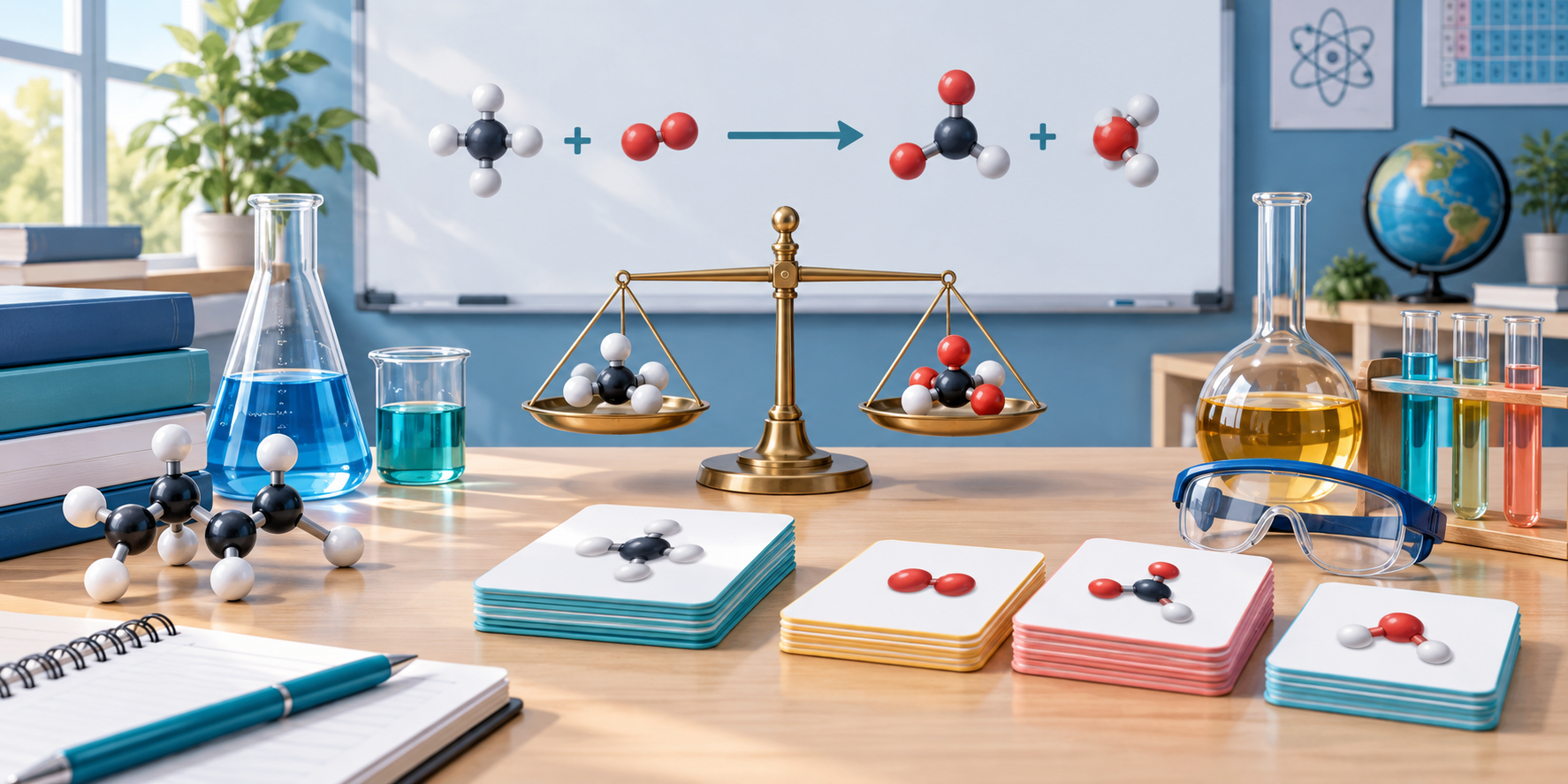
Learn how to memorize chemistry equations and reactions by understanding patterns, practising recall, balancing carefully, and fixing common exam mistakes.
Chemistry equations can seem like a long list of symbols that must be memorised perfectly. If you only copy them again and again, they are easy to mix up. A better approach combines understanding, patterns, active recall, and regular question practice. You need to know what the substances are, what type of reaction is happening, how to write the formulas, and how to balance the atoms. This guide explains how to memorize chemistry equations and reactions in a way that makes them easier to use in an exam.
Why chemistry equations feel hard
An equation carries several pieces of information at once. The symbols show the substances, the numbers show the ratio of particles, and the arrow shows the direction of the reaction. Conditions such as heat, light, a catalyst, or a solvent may also matter.
Many mistakes happen because students try to remember the finished line without understanding the reaction. They may know that an acid reacts with a metal but forget the products, use the wrong formula, or change a small number while balancing.
Start by separating the problem. Ask what the reactants are, what product family is expected, which formulas are needed, and whether the final equation is balanced. This makes the task more manageable.
Understand before memorizing
Before making flashcards, understand the reaction in words. For example, an acid and a metal can produce a salt and hydrogen gas. A metal carbonate and an acid can produce a salt, water, and carbon dioxide. The words give you a pattern that supports the symbols.
Use a simple three-step translation. First, write the word equation. Second, replace each substance with its correct chemical formula. Third, balance the equation by changing coefficients, not the small numbers inside formulas.
If you cannot explain what each substance represents, pause and review the topic. Understanding does not remove the need for memory, but it gives your memory a structure.
Build a reaction and formula list
Use your course specification or teacher checklist to make a master list of reactions. Divide it by topic or reaction type. Useful groups may include acids, metals, combustion, displacement, precipitation, electrolysis, energy changes, and organic reactions.
For every entry, record the word equation, symbol equation, conditions, reaction type, and one common mistake. Keep the list short enough to review. You can add a mark beside equations you often forget.
Do not copy reactions from random websites without checking that they match your course. Different levels and exam boards may require different details. Your official materials should decide what belongs on the core list.
Learn ions charges and formulas
Many equations become easier when you know common ions and how charges combine. Practise writing the formula of an ionic compound from the charges of its ions. Check that the total positive and negative charge is balanced.
Use small recall questions: What is the charge of this ion? What formula forms when these ions combine? Which element is represented by this symbol? What is the difference between a subscript and a coefficient?
Keep polyatomic ions together when you build formulas. If more than one is needed, use brackets correctly. A clean formula makes the later balancing step much easier.
Balance equations step by step
Balancing means making the number of atoms of each element the same on both sides. Start by writing the correct formulas. Then count each type of atom. Change coefficients in front of formulas until the counts match.
Never change the small subscript inside a chemical formula to balance an equation. That changes the substance itself. If you change H2O into H2O2, you have created a different compound rather than balancing the original reaction.
Balance one element at a time. Leave hydrogen and oxygen until later when they appear in several substances, unless your course uses a different method. Check the final equation by counting every atom again.
How do I balance a chemical equation?
Write the correct unbalanced formulas first. Make a count of each element on the left and right. Add coefficients in front of the formulas to fix one element, then recount all elements. Continue until the numbers match and reduce the coefficients to the simplest whole-number ratio.
Use a pencil while learning and say the count aloud. For a difficult equation, create a small table with the element names and the two totals. This helps you see which atom is still unequal.
Use patterns and reaction families
Reaction families reduce the amount you need to remember separately. If you know the pattern for acid plus metal, acid plus carbonate, or combustion of a hydrocarbon, you can predict the products before recalling the exact equation.
Build a family card with the general word pattern, one example, the conditions, and one exception or warning. Then cover the example and create a new one from the pattern. This tests whether you understand the family rather than only recognising one line.
Patterns are not permission to guess. Check the products and formulas against your course notes, especially when a metal has more than one possible charge or when the reaction conditions change.
Practise word to symbol translation
Exam questions may give you a word equation, a description, or a diagram and ask for a symbol equation. Practise moving between all three forms. Start with familiar examples and then mix the order.
When translating, identify each substance before writing symbols. Check the state symbols or conditions if they are part of your course. Then balance the equation and read it back in words.
This practice is important because a student can remember a symbol equation but still struggle when the exam describes the reaction differently. Flexible recall makes your knowledge useful.
Use active recall not copying
Copying an equation gives your hand practice but not necessarily your memory. Instead, cover the answer and produce it from a prompt. Ask yourself for the products, formulas, coefficients, conditions, or reaction type.
Use a blank page for a five-minute recall sprint. Write every reaction you can remember from one topic, then check the list. Mark missing or wrong equations and repeat them after a gap. Use flashcards for small facts, but include cards that require a full equation rather than only a single word.
An AI practice quiz can help you create mixed questions, but review the reasoning behind each answer. The goal is accurate recall under new wording.
Add calculations and conditions
Some chemistry equations connect to calculations. Practise using the equation to interpret ratios, relative formula mass, concentration, gas volume, yield, or energy changes when these skills are included in your course.
Always write units and show the working. A correct equation does not guarantee a correct calculation if you copy the wrong coefficient or ignore a conversion.
Review conditions too. Heat, pressure, light, catalysts, and solvents can affect whether a reaction occurs or which product is formed. Make conditions part of the recall prompt instead of leaving them for the last day.
Review common errors
Common errors include using the wrong formula, forgetting diatomic elements, changing subscripts, balancing only one side, and leaving an equation with fractions when whole numbers are expected. Another problem is confusing a reaction type with a product pattern.
Create an error log. Write the equation, the mistake, the correct version, and the rule that would prevent it. For example, “I changed a subscript, so I will only change coefficients when balancing.” Review the log before a practice set.
Ask why the mistake happened. If it is a memory problem, use more retrieval. If it is a formula problem, revise ions and charges. If it is a counting problem, slow down and make a table.
Practise mixed exam questions
Topic-by-topic practice is useful while learning, but mixed practice prepares you for the exam. Combine word equations, symbol equations, balancing, reaction types, calculations, and practical contexts.
Use a study timer for a short mixed set. Mark it carefully and separate knowledge mistakes from careless errors. Reattempt the wrong questions later without looking at the correction.
Past questions also show how chemistry is connected. An equation may appear inside a practical, data, or explanation question. Practise explaining what the reaction tells you rather than treating every equation as a standalone memory task.
Plan spaced chemistry sessions
A weekly plan might include one session for formulas and ions, one for reaction families, one for balancing, one for calculations, and one mixed exam set. Keep short recall reviews on other days.
Use a study planner to spread difficult equations across the week. Track which equations you can write correctly without notes. A study time tracker can help you see whether your revision includes enough question practice rather than only reading a list.
As an exam gets closer, practise under realistic conditions. Leave time to check formulas, coefficients, units, and conditions. Accuracy matters more than rushing through a large number of equations.
Frequently asked questions about chemistry equations
How many equations should I memorise?
Learn the equations required by your course and understand the reaction patterns behind them. The exact number depends on your syllabus. Use your specification and teacher checklist rather than trying to memorise every reaction you find online.
What should I do if I forget a formula?
Write the substance name, recall the relevant ion or element symbols, and build the formula from the charges or known pattern. If you still cannot remember it, make an error card and review it again later. Do not guess and keep the wrong formula in your notes.
Is rewriting equations a good revision method?
It can help at the beginning, but copying alone does not show whether you can recall the equation. Cover the answer, write it from a prompt, balance it, and explain the reaction. Use rewriting only as one small part of active practice.
Related AcademyNC tools
An AI practice quiz can test formulas, products, reaction types, and balancing. A study planner can organise chemistry topics across the week. A study timer can create focused equation practice blocks. The study time tracker can help you check whether you are revising both memory and exam questions.
Final thoughts
Chemistry equations become easier when you stop treating them as unrelated lines. Understand the reaction in words, learn common formulas and ion charges, use reaction families, practise translation, and balance with a clear process. Test yourself from memory and keep an error log for repeated mistakes. With short, spaced sessions, you can make equations more familiar without spending every evening copying the same page.




