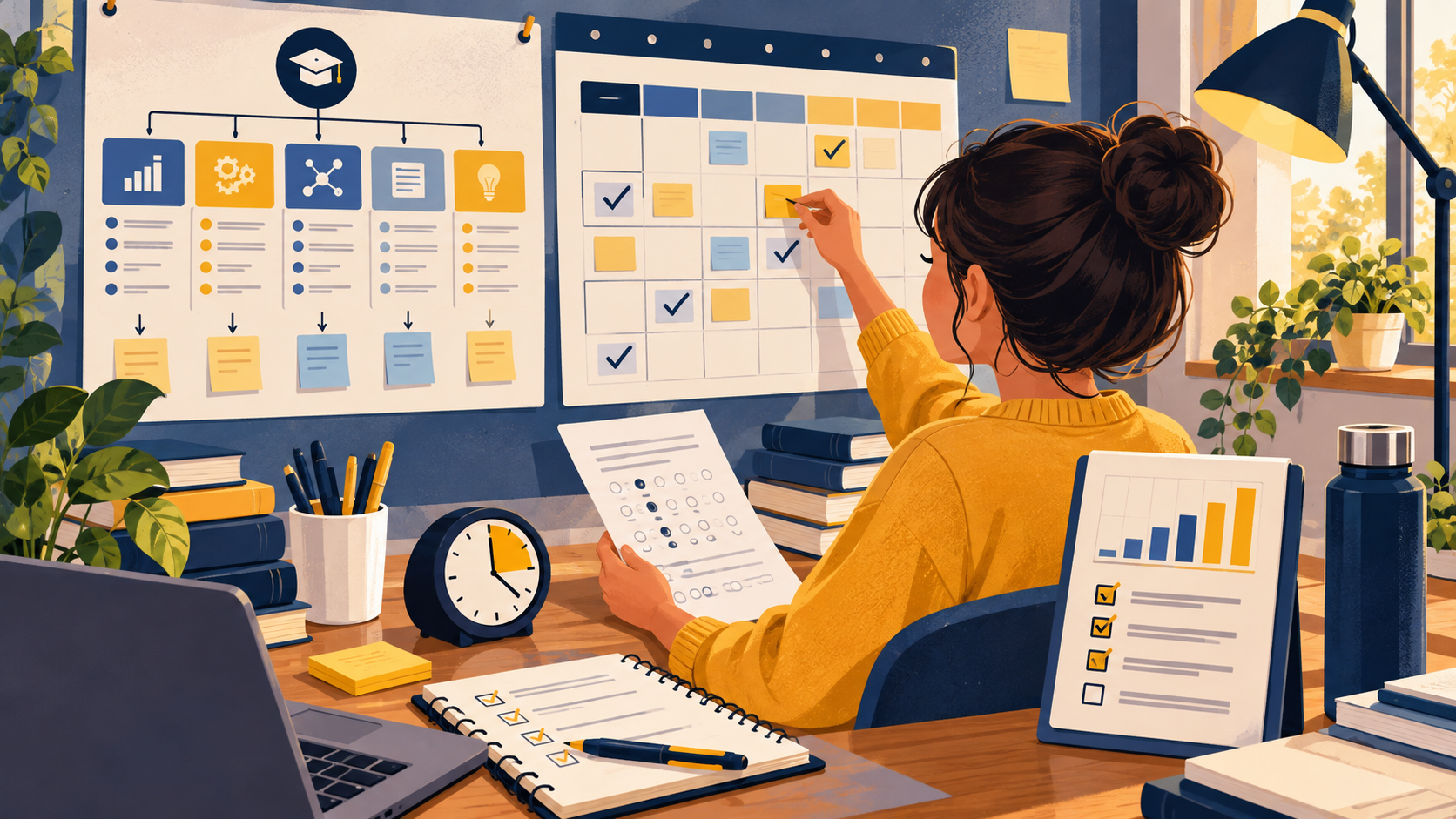
How to Plan Coursework Deadlines and Exams Together

Use one realistic plan for assignments, coursework, and exams so close deadlines do not turn into last-minute panic.
Coursework and exams compete for the same hours. An assignment may need research, reading, drafting, editing, and references. An exam may need topic review, practice questions, and timed work. If you plan them separately, both can look manageable until the deadlines arrive together.
A combined plan makes the pressure visible early. You can see which tasks need quiet thinking, which tasks fit into a short block, and where you need feedback. The aim is not to fill every minute. It is to make steady progress on the work that cannot be completed in one night.
Why one combined plan matters
Coursework often has a fixed due date, but its work is spread across many stages. Exams also have a fixed date, but revision can be moved unless you protect it. A good plan treats both as projects with smaller actions.
When you put them on one page, you can spot collisions. A research-heavy week may not be the right time for a full mock exam. A lighter assignment week may be the best time to finish a difficult topic. The plan helps you choose before the crisis chooses for you.
Collect every deadline
Write down exams, coursework due dates, draft checks, presentations, lab reports, reading responses, and smaller homework tasks. Include the date when feedback or approval is needed, not only the final submission date.
Check the official course page or teacher instructions. Your memory is not a reliable calendar when several subjects are moving at once. Put the task, subject, deadline, expected length, and required format in one list.
Measure the real workload
A deadline alone does not tell you how difficult a task will be. Estimate the stages. A short essay might need two hours of reading, one hour of planning, three hours of drafting, and an hour of editing. A long report may need research, data work, and several rounds of correction.
For exams, write the number of topics, question types, and practice papers. Do not count only the hours you want to spend. Count the useful study blocks that fit around classes, travel, meals, sleep, and other responsibilities.
Rank deadlines by risk
The nearest deadline is not always the biggest risk. A task with unclear instructions, a heavy research load, or a difficult method may need an earlier start. An exam that covers a wide syllabus may also need steady revision even when it is weeks away.
Rate each task for urgency, size, difficulty, and uncertainty. A high-risk task deserves an early first step. Starting early gives you time to ask a question, discover a missing source, or change the plan without losing the whole week.
Work backwards from the due date
Start with the final deadline and move backwards. Add a final proofread, upload check, or submission buffer before the official time. Then place the draft, outline, research, reading, and topic selection before it.
Do the same for exams. Place a final light review before the exam, timed practice earlier, and topic repair before that. Working backwards turns a vague deadline into a sequence of finish lines you can actually complete.
Separate deep work from small tasks
Deep work includes planning an argument, reading a difficult paper, solving a set of problems, or writing a first draft. Small tasks include checking a reference, naming files, making a list of sources, or reviewing vocabulary.
Put deep work in the time of day when your mind is strongest. Use short gaps for small tasks. A study timer can protect a deep block, while a short checklist can stop small jobs from spreading across the whole day.
Build a weekly dashboard
At the start of the week, list the two or three outcomes that matter most. Under each one, write the next action and the finish line. For example, choose three sources and write a working question is clearer than work on report.
Leave space for current homework and unexpected tasks. A plan that uses one hundred percent of your time has no way to absorb a slow commute, a difficult question, or a teacher message. Use the study planner to see the week before you commit to it.
Protect steady progress
Coursework benefits from frequent small progress. Open the document, write a rough paragraph, make a source note, or solve one example even when you cannot do a long block. This keeps the task familiar and reduces the fear of starting.
Exam revision also needs continuity. Keep short recall or practice blocks during heavy coursework weeks. You may reduce the amount, but avoid disappearing from a subject until the night before the test.
Leave room for feedback
If your teacher can check a plan, question, outline, or first paragraph, schedule that check before the final week. Feedback is useful only if you still have time to act on it.
Write down the question you want answered. Instead of asking whether the assignment is good, ask whether the argument answers the question, whether the evidence is relevant, or whether the method is clear. Specific feedback is easier to use.
Plan around exam revision
When an exam is close, switch coursework tasks to clear milestones. Finish the research, then protect revision blocks. Avoid leaving a large open-ended writing task beside a final exam week if you can complete the structure earlier.
For revision, use the assessment format. If the exam requires essays, schedule essay plans and timed writing. If it requires calculations, schedule problem sets. This stops coursework planning from consuming every available hour while revision stays too general.
Use buffers for real life
Keep a small buffer before important deadlines. Your first draft may take longer than expected. An upload may fail. A group member may send work late. A new lesson may change the assessment focus.
Buffers are not wasted time. They are what lets you respond without cancelling sleep or turning one late task into three. If the buffer remains free, use it for a weak exam topic or an early next step.
Check your plan twice a week
A plan is a decision tool, not a promise. Check it after a few days. What is complete? What took longer? What new information arrived? Move tasks while they are still small.
Use the study time tracker to compare planned and actual time. If an assignment repeatedly takes twice as long as expected, change the estimate and ask for help. Better data makes the next plan more honest.
What to do when work slips
Do not copy every missed task into tomorrow. Recalculate. Protect the nearest high-risk deadline, reduce the size of the next action, and move lower-risk work to a realistic later block.
If a task is unclear, ask a teacher or classmate. If the workload is not possible alongside other deadlines, speak early rather than waiting until submission day. A smaller clear plan is more useful than a perfect plan you cannot start.
Common planning mistakes
Do not make separate calendars that hide collisions. Do not schedule only final products. Do not assume every task needs the same energy. Do not forget editing and feedback. Do not use late nights as your normal buffer.
Also avoid planning every hour without breaks. Rest and meals protect the quality of your thinking. Your plan should help you finish work and remain able to learn the next day.
Frequently asked questions about coursework and exams
Should I finish coursework before revising?
Not always. Work on the highest-risk task first, while keeping a small amount of exam practice moving. If the coursework deadline is close, protect its next milestone, but do not abandon an exam that is also approaching.
How much time should I leave for feedback?
Leave enough time to make meaningful changes, not only correct spelling. For a short assignment, a few days may help. For a large project, ask early about draft checks and build the feedback stage into the plan.
What if two deadlines fall in the same week?
Break both into stages immediately. Compare their size, uncertainty, and marks. Finish the first visible milestone for each, then give the largest blocks to the work with the highest risk. Ask for support if the total load is not realistic.
Related AcademyNC tools
Use the study planner to place coursework milestones and revision blocks. Use the study time tracker to compare estimates with real progress. A study timer can protect deep work, and an AI practice quiz can keep exam revision active during assignment-heavy weeks.
Final thoughts
Coursework and exams become easier to manage when you stop treating them as two giant tasks. List every date, measure the stages, work backwards, protect steady progress, and leave room for feedback and real life.
The best plan is not the busiest one. It is the one that shows what to do next and still works when a day goes differently than expected.