
How to Prepare for a Closed-Book Exam
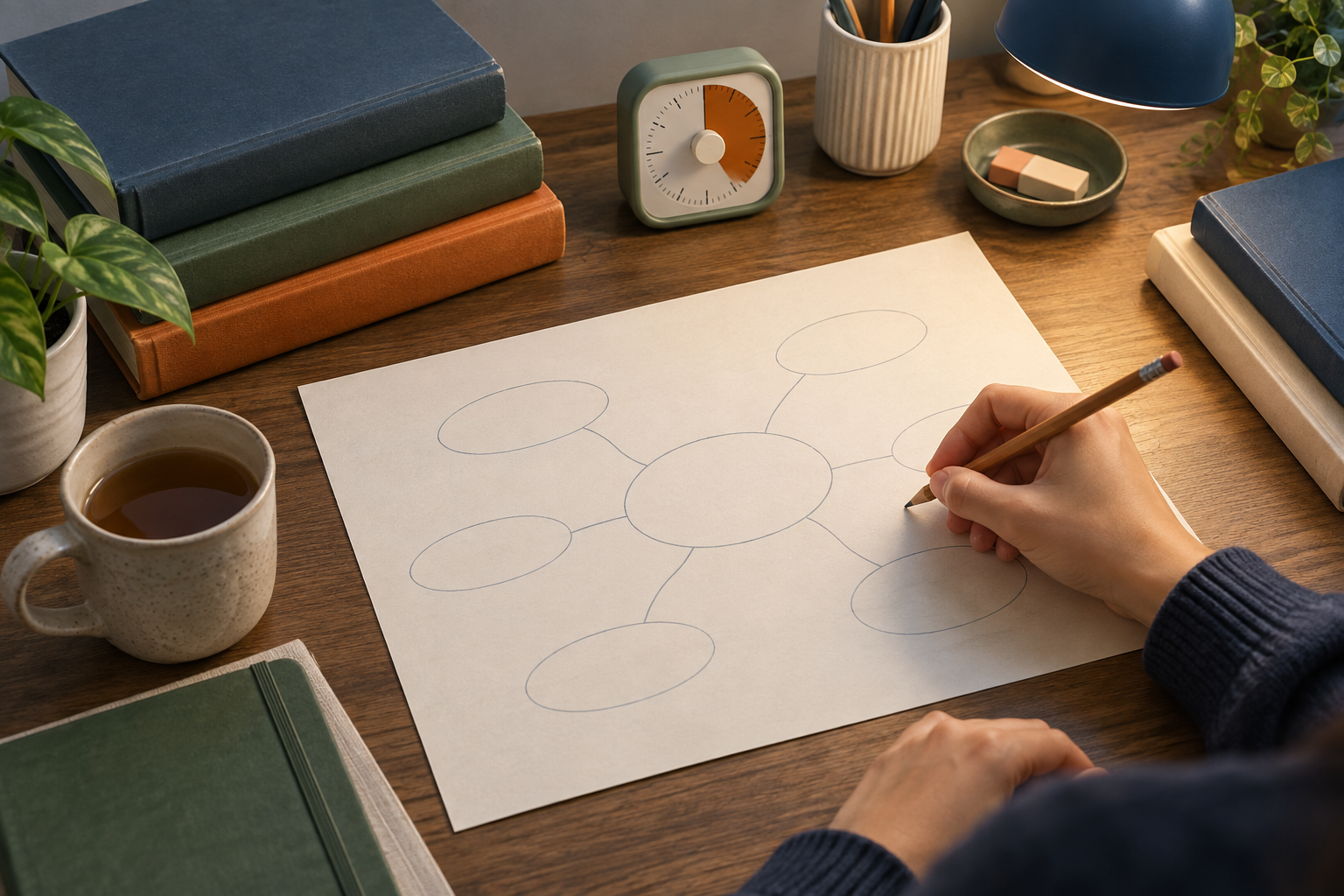
Learn how to prepare for a closed-book exam with a clear topic outline, active recall, brain dumps, timed practice, and a simple plan for exam day.
A closed-book exam asks you to bring the knowledge with you instead of checking a textbook or note sheet. That can feel stressful, especially when you are used to recognising information while reading. The solution is not to copy notes for longer. You need a system that helps you learn the topic, retrieve it without help, apply it to questions, and notice the gaps before exam day. This guide explains how to prepare for a closed-book exam in a calm and practical way.
Why closed-book exams need a system
A closed-book paper tests more than memory. You may need to recall a definition, choose a method, explain a process, compare ideas, or build an argument. Knowing a fact in isolation is not enough if you cannot connect it to the question.
Many students wait until the last week to test themselves without notes. By then, rereading has created a feeling of confidence but there is little time left to repair weak areas. Start active recall early, even when your answers are incomplete.
A good system gives every topic a place, every session a task, and every mistake a next step. You do not need to remember everything perfectly on the first attempt.
Read the assessment rules
Check the format, timing, sections, permitted equipment, and question types. Some closed-book exams allow a calculator or formula sheet, while others do not. Make sure your preparation matches the actual rules.
List the content and skills that can be tested. Include key terms, processes, examples, calculations, diagrams, essays, and practical methods if they are part of the paper.
Use official guidance from your teacher, course, or exam board. An online study method can help, but it cannot replace the details of your assessment.
Build a topic outline
Make a one-page outline for each major topic. Start with the central idea, then add definitions, steps, examples, comparisons, formulas, and common question types. Keep the outline short enough to review.
The first version can use your notes. The next version should come from memory. Close the book, write the headings, and fill in what you know. Compare your attempt with the source and mark the missing parts.
An outline is not a script for the exam. It is a map that helps you see which ideas connect. The more you use it for recall, the less you will need to look at it.
Learn active recall early
Active recall means trying to produce information before checking it. Use questions, flashcards, blank pages, spoken explanations, or practice problems. The method feels harder than rereading because it shows what you cannot yet remember.
Start with direct prompts. What is the definition? What are the stages? What is the formula? Then add application prompts. Why does this happen? What would change if one condition changed? How would you compare these two ideas?
Check the answer immediately after the attempt. Correct the gap, then try again later. The goal is not to avoid mistakes. It is to use mistakes as a guide.
Use brain dumps and blank pages
A brain dump is a short period where you write everything you can remember about a topic without looking. Use a blank page and a timer. Do not worry about perfect sentences at first.
When time ends, compare the page with your outline. Circle missing terms, incorrect links, and areas you could not explain. Then close the notes and add the corrections from memory.
Blank-page recall also works for diagrams, formulas, essay plans, and process steps. It is especially useful before a practice paper because it shows what is available without support.
Practise question types
Learn the content through the question formats that will appear. Complete short definitions, calculations, explain questions, data tasks, essays, multiple-choice questions, or practical questions as needed.
Begin without a time limit while you learn the method. Then add timing. Mark the work carefully and separate knowledge gaps from exam-skill gaps. If you know the topic but cannot structure the answer, practise the structure directly.
Mix topics after the basics are secure. A mixed set makes you decide which idea or formula applies, which is closer to what happens in the real exam.
Condense notes into memory cues
As the exam approaches, reduce long notes into prompts. A prompt might be a keyword, diagram, question, first letter, or short comparison table. Use the cue to produce the full explanation from memory.
Do not condense before you understand. A short sheet made from confusion will only hide the problem. First learn the topic, then reduce it.
Keep cues personal and clear. A memory cue that only makes sense when you read the original page is not useful. Test whether you can rebuild the answer from it after a gap.
Train timing without notes
Use a study timer for realistic practice. Start with a short section, then a longer group of questions, and later a full paper. Follow the same process each time: read, plan, answer, and check.
Notice where time disappears. You may be writing too much for low-mark questions, spending too long on one problem, or forgetting to plan before a long answer. Adjust the habit rather than simply trying to work faster.
Leave a few minutes to check units, definitions, calculations, labels, and conclusions. A closed-book exam rewards accurate work, not only fast work.
Use feedback and an error log
Write down mistakes while they are fresh. Record the question, your answer, the correct idea, and the reason for the error. Add a next action such as “review the difference,” “practise three similar problems,” or “write a paragraph plan.”
Review the log before the next session. If the same error appears, change the method. Ask for help, use a simpler example, or practise the skill with notes before trying again without them.
Do not judge your progress only by a score. A lower score on a difficult mixed paper can still help if you understand and repair the errors.
Prepare for exam day
The day before, review memory cues, key definitions, formulas, common mistakes, and a few representative questions. Avoid trying to relearn the whole course overnight.
Pack the equipment allowed by the rules. Sleep enough to protect attention. On the morning, use a short recall session if it calms you, but stop before it becomes a panic search through every topic.
When the exam starts, read the instructions and use the space provided for rough work. If a brain dump helps you, write only key formulas, terms, or structures that you know you may need. Then focus on the question in front of you.
Frequently asked questions about closed-book exams
How should I start preparing for a closed-book exam?
Start with the assessment rules and a topic checklist. Learn each topic, close your notes, and retrieve the main ideas. Add practice questions early so you can see whether your memory works under the exam format.
Is rereading useful for a closed-book exam?
Rereading can help you understand a topic at the beginning, but it does not prove that you can recall it. Follow reading with a closed-book explanation, blank-page recall, or practice question.
What should I do if my mind goes blank?
Pause, breathe, and write any related term, formula, example, or first step you remember. A small starting point may bring back the structure. Move to another question if needed and return later. Regular practice without notes makes blank moments less frightening.
Related AcademyNC tools
A study planner can spread topics and recall sessions across the weeks before the exam. A study timer helps you practise short brain dumps and full timed papers. An AI practice quiz can test recall without your notes. The study time tracker can show whether you are spending enough time testing yourself rather than only reading.
Final thoughts
Closed-book exam preparation works best when you practise retrieving knowledge early and often. Build a topic outline, use brain dumps and blank pages, complete the real question types, and keep an error log. Condense notes only after you understand them, then use memory cues to rebuild the full answer. You do not need to feel perfectly confident before you begin testing yourself. Each honest attempt shows you where the next useful session should go.




