
How to Prepare for an Open-Book Exam Without Cramming
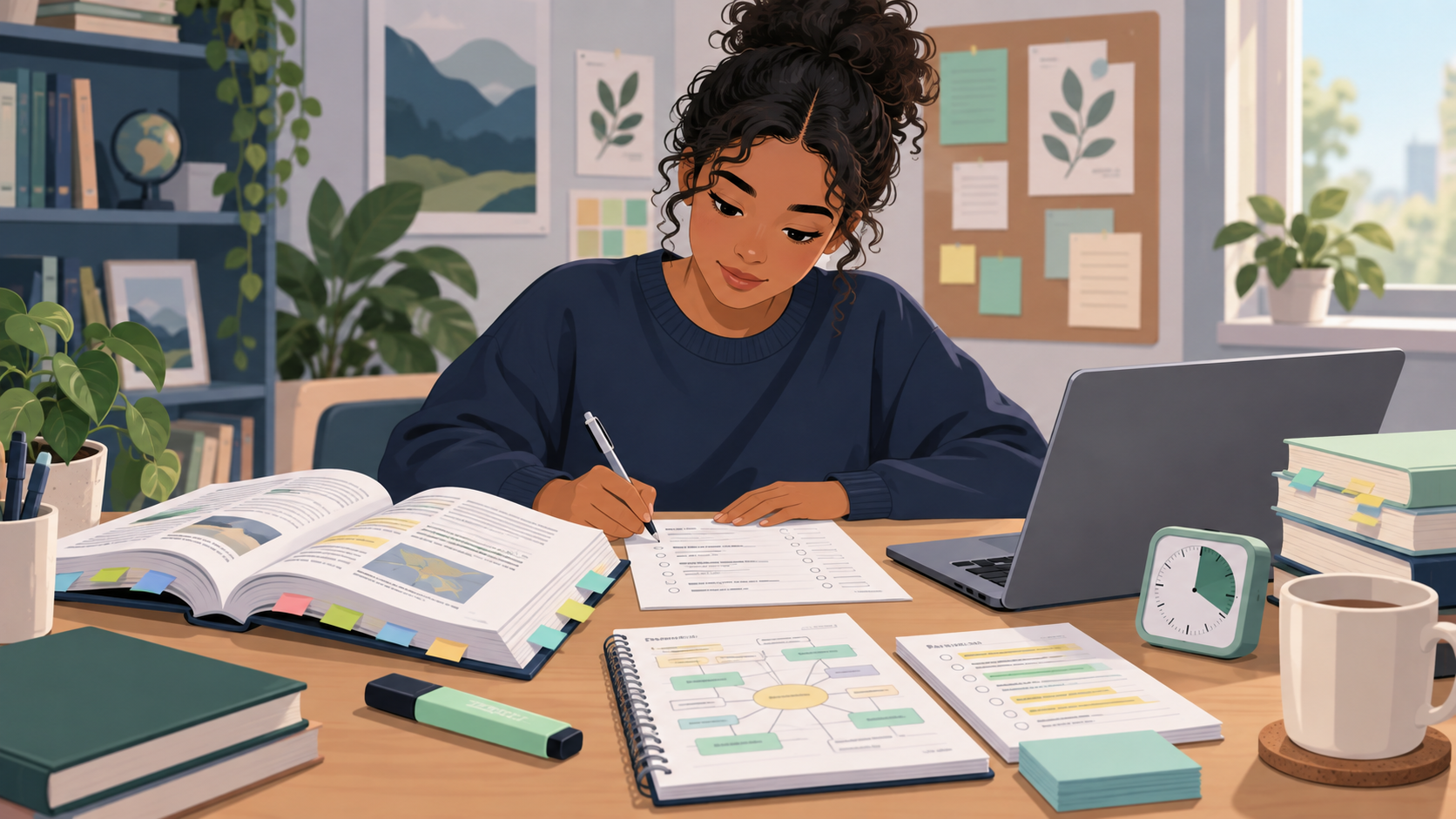
Open-book exams still require preparation. Learn how to study the concepts, organize reference notes, practise finding evidence, and manage time during the test.
An open-book exam can sound easier than a closed-book exam. After all, you are allowed to bring notes or use a textbook. But open-book tests still require preparation. The questions may ask you to apply ideas, compare evidence, explain a case, or solve a problem that is not copied from one page.
The book is a support tool, not a replacement for knowing the course. If you spend the exam searching for every definition, you may run out of time before you can build a good answer. The best preparation helps you understand the main ideas, organize your references, and practise finding useful information quickly.
This guide explains how to prepare for an open-book exam without cramming. You will learn what changes in an open-book test, how to build a reference system, how to practise with questions, and how to manage your time during the exam.
Understand what an open-book exam changes
An open-book exam reduces the need to memorize every small detail, but it does not remove the need to learn. You still need to recognize the topic, understand the question, choose the right source, and use the information accurately.
Many open-book questions test connections. You may need to use two ideas together, explain why a rule applies, or compare examples. Reading a chapter during the exam is slow. Understanding the chapter before the exam makes the book much more useful.
Read the exam rules first
Find out exactly what the rules allow. Check whether you can use a printed textbook, handwritten notes, digital files, online sources, or only a provided resource. Check whether the exam is in a classroom, at home, or inside a locked browser.
Also check whether you can highlight, add tabs, use a calculator, or search a PDF. Do not assume that an open-book exam means the whole internet is allowed. Follow the instructions from your school or college and prepare only the materials that are permitted.
Learn the concepts before organizing notes
Start with understanding, not decoration. For each topic, explain the main idea in simple words, work through an example, and write what could go wrong. If you cannot explain a concept without looking at the page, it may be too early to spend time making tabs.
Use active recall while studying. Close the book and answer questions from memory. Draw a process, solve a problem, or explain how two ideas connect. Then open the book to check your explanation. This keeps the open-book resource as a backup rather than your first move.
Build a small reference pack
Your reference pack should be quick to scan. Include a contents page, topic summaries, important definitions, formulas or rules, common examples, and a list of mistakes to avoid. Keep each section short and put the most useful information near the beginning.
Write page numbers or file names beside important ideas. If your material is digital, use clear headings and a consistent search term. If it is printed, use a small number of coloured tabs. Too many tabs create visual noise and make it harder to choose.
Create an index and map
An index answers “Where can I find this?” A map answers “Which idea should I use?” Make both. List the topic, the source page, and one phrase that reminds you what the section does.
For example, your index might say “sampling bias — methods notes, section 3 — use when a sample does not represent the population.” That final phrase helps you decide whether the source is relevant instead of sending you on a random search.
Practice finding information quickly
Searching is a skill you can practise. Choose a question and give yourself two minutes to locate the relevant page or note. Stop when you find the main source, then explain the answer in your own words.
Do not search every tiny fact. Practise the searches you are likely to need: a definition, an example, a rule, a case study, or a formula. If a term can be called three different things in your notes, choose one standard label and use it everywhere.
Use timed practice questions
Open-book exams still need timed practice. Choose questions that match the real format and set a shorter time at first. Keep your reference pack nearby, but try to answer from memory before searching.
Record how long you spend reading, planning, finding evidence, writing, and checking. If the search takes half the time, your notes need improvement. If the writing takes too long, practise planning shorter answers and using evidence more directly.
Practise applying sources, not copying them
A strong answer uses a source to support a point. It does not paste a paragraph and hope the examiner sees the connection. After finding a useful passage, close the book or look away from the page and write the idea in your own words.
Then explain how it answers the question. Ask, “What does this evidence show?” and “Why does it matter here?” This extra step is often what separates a list of facts from a clear exam response.
Prepare for online open-book exams
If the exam is online, test your setup before the day. Know where your permitted files are stored, how to search them, and how to move between the exam and a reference document if the rules allow it. Keep file names simple and open only what you need.
Do not rely on a weak internet connection or a last-minute download. Save permitted materials offline if the instructions allow it, and check the format on the device you will use. If the exam has special rules, ask the school or college before the test.
Manage time inside the exam
Read all instructions carefully and scan the marks or suggested time. Give more time to questions worth more marks, but leave a few minutes for checking. If a question is difficult, write a short plan and move on rather than searching endlessly.
Use a two-pass approach. On the first pass, answer what you know and mark places where you need a reference. On the second pass, look up only the information that will improve an answer. This prevents one difficult detail from stealing time from easier marks.
Know what to bring on exam day
Prepare the allowed book, notes, calculator, pens, water, and any required identification. Put tabs or labels in place before the exam. If digital resources are allowed, charge the device and test the files.
Keep the desk simple. A crowded pile of resources can slow you down. Bring the smallest set that covers the course and is easy to search. Preparation should make choices faster, not create more choices.
Common open-book exam mistakes
The first mistake is leaving study until the last day because the book is allowed. You still need to learn the concepts and practise the question style. Another mistake is highlighting every line. If everything is marked as important, nothing is easy to find.
Students also create notes that are too long. A ten-page summary may be accurate but difficult to use under time pressure. Reduce each topic to the ideas, examples, and warnings you actually need.
Do not forget to practise without the book sometimes. If you always search before thinking, you may become dependent on the resource. Recall the main structure first, then verify the detail.
Frequently asked questions about open-book exams
What should I study for an open-book exam?
Study the concepts, relationships, common question types, and important examples. Organize the details you are allowed to use, but do not spend all your time making notes that you do not understand.
Can I rely on my textbook during the exam?
Use it as a reference, not as your main memory. Searching every answer takes time and can make it hard to build a clear response. Learn the structure of the course so you know where to look when you need help.
How should I organize open-book exam notes?
Use clear headings, short summaries, page numbers, and a simple index. Group related ideas together and add a note about when each source is useful. Keep the pack small enough to scan quickly.
Are open-book exams easier?
They can feel less stressful for memorization, but the questions may demand more explanation and application. Difficulty depends on the course and the exam design. Prepare for reasoning, not just recall.
What if I cannot find the answer?
Make your best attempt from what you understand, leave a note about the missing detail, and move on. Return later if time allows. A partial answer with clear reasoning is usually better than losing several minutes to a search.
Final thoughts
An open-book exam rewards preparation that is practical. Learn the concepts, build a short reference pack, create an index, practise finding evidence, and answer timed questions. During the test, think first, search with a purpose, and protect your time. The book can support your knowledge, but it cannot replace it.
Related AcademyNC tools
Use the Study Planner to schedule concept review and timed practice before the test. Grade Tracker can help you record results after the exam, AI Practice Quiz can create extra questions, and the Study Time Tracker can show how long your practice sessions take.




