How to Prepare for Mock Exams: A Practical Revision Plan

Build a realistic mock exam revision plan, use past papers properly, review mistakes, and turn your mock results into a stronger study routine.
Mock exams are a useful rehearsal for the real thing. They show what you remember, but they also show how you manage time, read questions, and stay focused when the paper feels difficult. You do not need to revise every topic in the same way. A better approach is to find your weak areas, make a realistic plan, and use practice papers to improve one problem at a time.
This guide explains how to prepare for mock exams without turning the weeks before them into panic. You will learn how to check the content, use earlier results, practise under realistic conditions, and turn your mistakes into a plan for the next test.
Why mock exams are useful
A mock exam is more than a prediction of your final grade. It is feedback. It can show that you know the content but lose marks because you rush, miss command words, or give answers that are too short. It can also reveal topics that feel familiar when you read your notes but are difficult to recall without help.
Treat the mock as information, not a judgement about your ability. The result is one snapshot of your current preparation. If you use it to choose what to practise next, it can make your real exam preparation much more focused.
Find out what the mock will cover
Ask your teacher or check your course information before you make a revision timetable. Write down the subjects, papers, units, topics, and question styles included. Check whether calculators, formula sheets, sources, texts, or practical skills are part of the mock.
Do not spend most of your time revising topics that will not appear. At the same time, do not ignore a topic just because it was not in your last class test. A short content checklist helps you see the full boundary and stops your plan from being based on guesses.
Use your last results to set priorities
Look at your previous test papers, homework, or quiz results. Separate the problems into three groups: knowledge you forgot, questions you understood but answered poorly, and mistakes caused by timing or carelessness. Each group needs a different fix.
If you forgot a topic, use active recall and small practice questions. If you knew the idea but lost marks, practise the question type and compare your wording with a mark scheme. If timing caused the problem, complete timed sections and practise moving on from questions that are taking too long.
How early should I start revising for mocks?
Start as soon as you know the mock content, even if the exam is several weeks away. Early revision does not mean studying for hours every night. It means making a small plan, checking your weak areas, and giving yourself time to revisit difficult topics.
If the mock is close, prioritise the highest-value topics and the skills that affect many questions. A focused week can still help, but do not try to learn an entire course in one night. Use the time you have for active practice rather than endless rereading.
Build a realistic mock exam plan
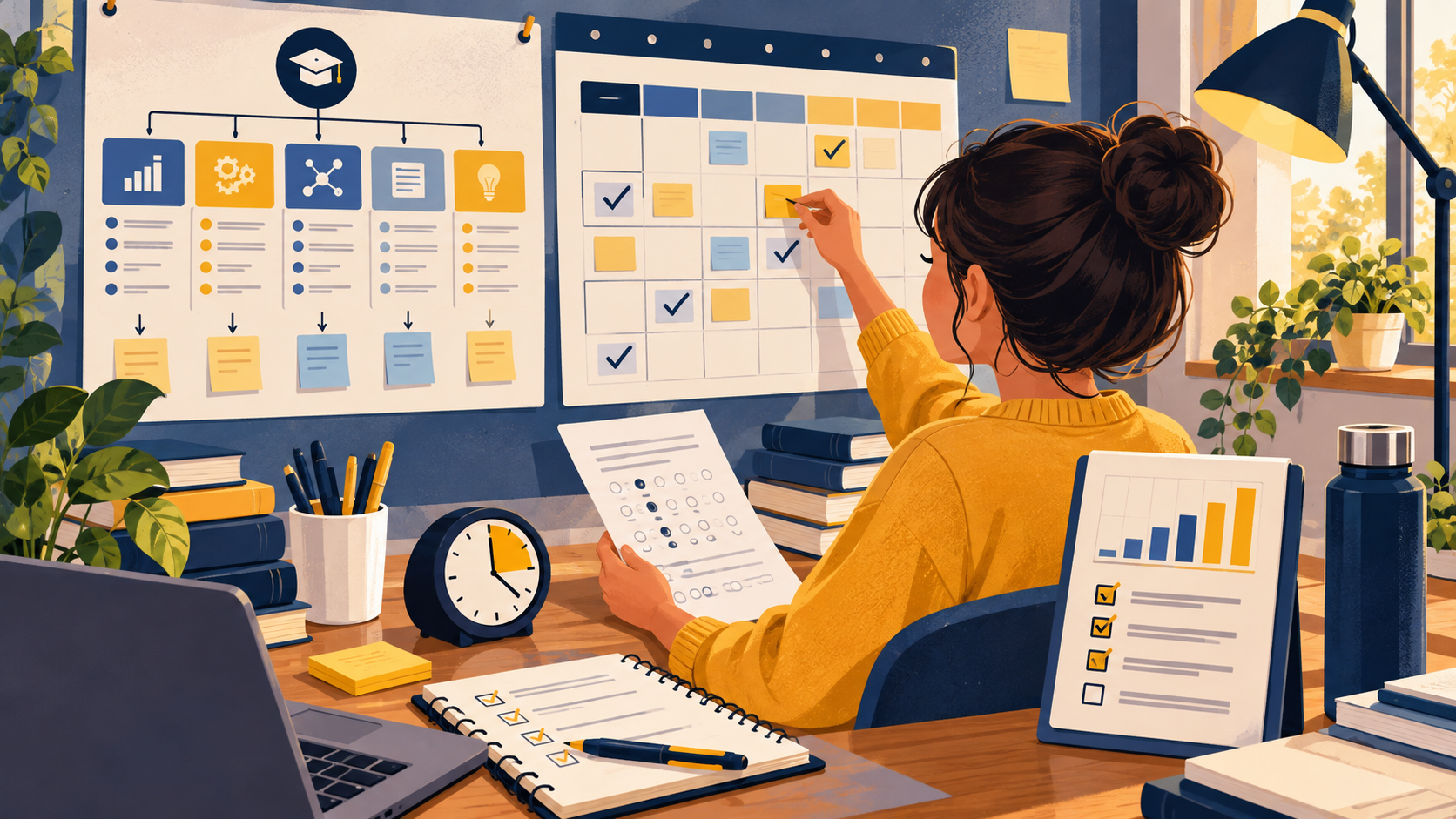
Make a list of available study sessions for the week. Add school, travel, meals, rest, and other responsibilities before assigning revision. Then split each session into a small task, such as learning a process, answering ten questions, or reviewing one past paper section.
Give difficult topics more than one session. Leave space for review because you may discover new weak areas as you practise. A study planner can help you see the week clearly and stop one subject from taking all your time.
Revise knowledge before doing papers
Past papers are most useful when you have enough basic knowledge to learn from them. Start with short recall questions, key terms, formulas, diagrams, or worked examples. Close your notes and try to retrieve the information. Then check what you missed.
An AI practice quiz can give you extra questions when you have already used the exercises in your textbook. Mix old and new topics so you practise choosing the right method, not only answering questions in the order you learned them.
Practise in real exam conditions
Complete at least part of a mock paper without notes, notifications, music, or interruptions. Use the time allowed, follow the instructions, and write answers in the way you will use in the exam. This is not only a test of memory. It is practice for concentration and pacing.
Use a study timer to set the working period and to learn how much time different sections take. After the paper, write down where you slowed down. If you finished early with many unanswered questions, practise checking and developing your responses. If you ran out of time, practise shorter planning and moving on.
Use past papers without wasting them
Do not complete every past paper immediately. Save some papers for later so you can measure progress. For your first paper, you can use it as a diagnostic. Mark it carefully and choose two or three topics to fix. Then complete a few targeted questions before attempting another full paper.
When you use a paper, record the date, conditions, score, and main problem. This makes progress visible. A paper that feels difficult today can become evidence of improvement when you return to a similar paper after focused practice.
Review mistakes by type
Marking a paper is only the first step. Go through every lost mark and label the reason. Useful categories include forgotten knowledge, misunderstood question, missing explanation, weak application, calculation error, poor structure, and timing.
Look for patterns rather than worrying about one incorrect answer. If five mistakes are all caused by missing units, your next session should include unit practice. If many answers are too general, practise using the case study or source detail in the question.
Fix weak topics with targeted practice
Turn each error category into a small action. For forgotten facts, make a short retrieval set and test it again tomorrow. For weak explanations, write a cause-and-effect chain. For question technique, complete two examples and compare them with the mark scheme. For timing, use shorter timed sections before trying a full paper again.
Do not rewrite every page of notes. Targeted practice gives you more useful feedback and leaves time for other subjects. Track your sessions with the study time tracker, but also record what improved. Time alone does not show whether the method is working.
Protect sleep and confidence
Sleep is part of exam preparation. A tired brain finds recall, reading, and decision-making harder. Keep a regular bedtime where possible and use breaks during longer sessions. Short breaks can help you return to a difficult topic with more attention.
Confidence does not mean believing that every question will be easy. It means knowing what you will do when a question is hard. Practise skipping and returning, writing a quick plan, and using the marks to guide your answer. These small habits make difficult moments less frightening.
Prepare for the mock exam day
Check the time, room, equipment, calculator rules, and any materials you need. Pack pens, pencils, an eraser, a ruler, and a calculator if allowed. Check travel time and give yourself a buffer so a late journey does not create extra stress.
On the morning, review only short prompts, formulas, or key terms. Avoid trying to learn a whole new topic as you walk into the room. Eat and drink in a way that suits you, arrive early, and read the instructions before starting.
Should I do a full paper every day?
Usually not. Full papers are tiring and can be less useful than targeted practice when you repeat the same mistakes. Use a full paper to diagnose your level, then spend time fixing the problems it reveals. Complete another paper later to check whether the changes helped.
If you have several subjects, balance full papers with short questions, flashcards, and focused review. Quality feedback matters more than the number of papers you finish.
What should I do after a bad mock result?
Give yourself a short break, then look for patterns in the paper. Separate knowledge gaps from exam-technique or timing problems. Choose a few actions you can complete, such as revising one weak topic, practising one question type, or asking your teacher about a confusing point.
A bad mock result is useful when it changes your plan. Do not spend the next week simply rereading everything because you feel worried. Use the paper to decide exactly what needs attention.
Frequently asked questions about mock exams
How many hours should I revise for a mock?
There is no useful number for every student. Plan regular sessions that fit your timetable and attention span. A focused thirty-minute session with practice can be better than two hours of distracted reading.
Should I revise my strongest subject first?
Use a mixture. Starting with a comfortable subject can help you begin, but protect enough time for weaker topics. Your results and upcoming exam dates should guide the balance.
How do I know if I am ready?
Try questions without notes, mark them honestly, and check whether your score and timing are improving. You are not looking for a perfect paper every time. You are looking for fewer repeated mistakes and more control when a question is unfamiliar.
Related AcademyNC tools
Build the plan in your study planner, work in focused blocks with the study timer, and use an AI practice quiz for extra recall. Record your effort and weak areas with the study time tracker.
Final thoughts
The best mock exam preparation is a cycle: check the content, practise, mark the work, find the pattern, and fix one problem at a time. Start early enough to revisit difficult topics, but keep the plan realistic so you can follow it.
Mocks are practice, not a final label. Use the feedback well and your next exam can show more than what you knew on the first attempt. It can show how much your method has improved.