
How to Read a Research Paper Efficiently as a Student: A Practical Method
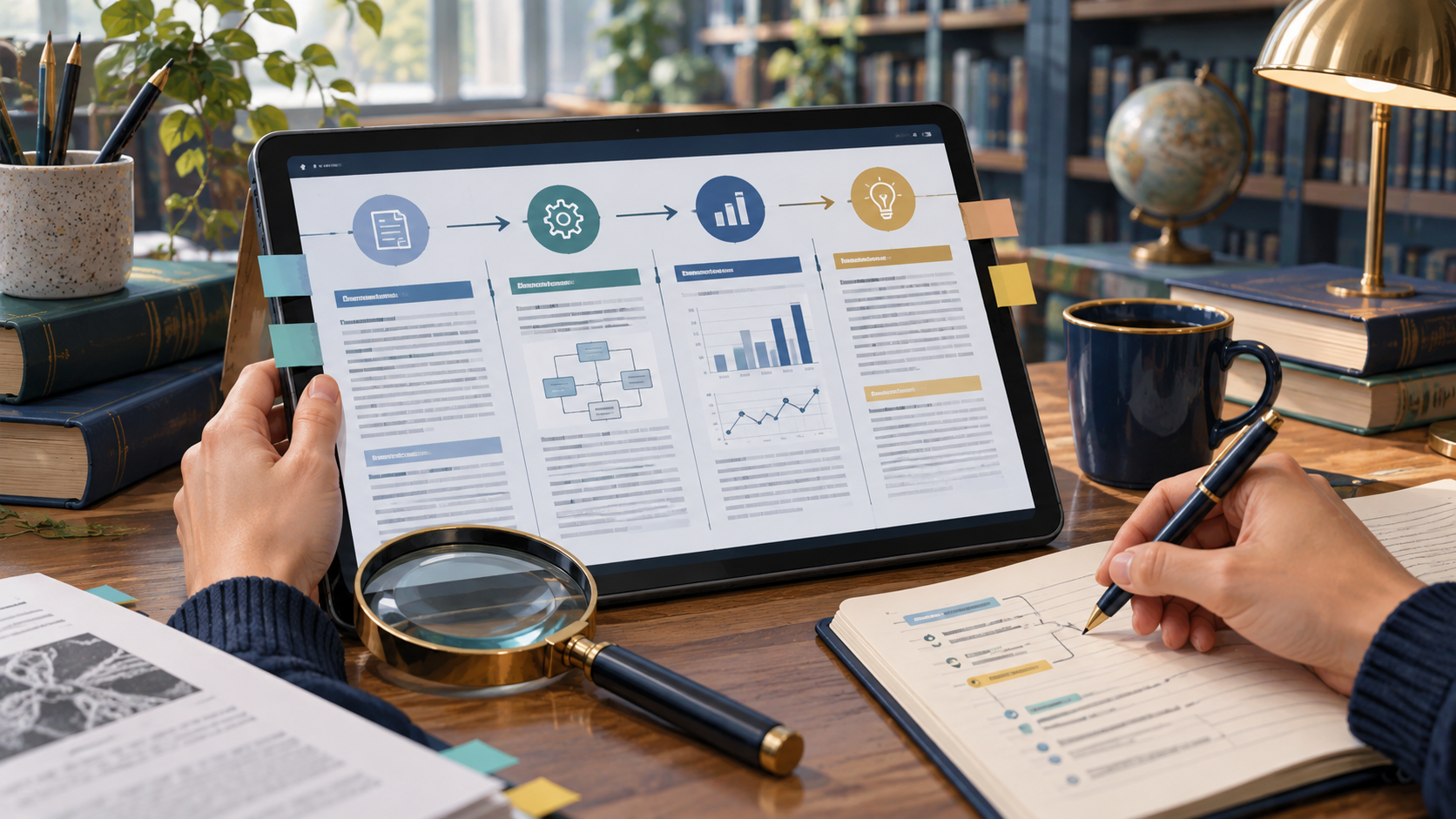
Learn how to read a research paper efficiently as a student with a three-pass method for relevance, methods, results, critical evaluation, and useful notes.
Research papers are written for specialists, so reading one from the first line to the last can feel slow and confusing. That does not mean you are a poor reader. Academic papers use a compact structure, assume background knowledge, and often answer a narrow question with evidence rather than telling a simple story.
Learning how to read a research paper efficiently as a student means matching your reading depth to your purpose. You should be able to decide whether a paper is relevant, identify its question and main claim, understand the evidence, evaluate its limits, and save notes you can use later. This guide gives you a repeatable multi-pass method for class readings, literature reviews, lab reports, and research projects.
Start with your purpose, not the first paragraph
Before opening the paper, write down why you are reading it. Your purpose changes the route you should take. If you only need to decide whether it belongs in a literature review, you need a quick relevance scan. If you must present the study, you need a careful reading of the methods and results. If you are studying for an exam, you need the question, concepts, evidence, and implications.
PurposePrioritizeUseful output
Check relevanceTitle, abstract, keywords, conclusionKeep, skip, or read later
Understand the studyQuestion, methods, results, limitationsShort evidence summary
Prepare a presentationStory, figures, findings, implicationsSlide outline and discussion questions
Write a paperClaim, evidence, methods, related workSource note with accurate citation
Knowing your purpose also protects your time. Not every paper deserves a deep reading, and efficient reading is not the same as rushing through material you need to understand.
Use a three-pass reading method
A three-pass approach helps you move from structure to meaning to evaluation. You may finish a short paper in three passes or pause between passes across several study sessions.
Pass one: map the paper
Read the title, abstract, headings, figures, tables, conclusion, and references. Look for repeated terms and the overall structure. Do not stop to define every unfamiliar word yet. At the end of this pass, write three sentences: What question is the paper asking? What did the authors claim? What evidence seems central?
Check whether the paper is actually relevant to your assignment. Note the population, subject, field, or time period. A paper can be interesting without being useful for your specific question.
Pass two: follow the argument
Read the introduction for the problem and research gap, the methods for how the study was conducted, the results for what was observed, and the discussion for how the authors interpret it. Add a short note after each section. If the paper has a standard IMRaD structure—introduction, methods, results, and discussion—use those headings as a map.
Ask what each paragraph contributes. Is it background, a claim, evidence, a limitation, or a transition? If a paragraph does not seem clear, identify its role first. Structure often makes difficult sentences easier to interpret.
Pass three: test and evaluate
Close the paper and reconstruct its logic from memory. State the research question, the method, the most important result, and the authors' conclusion. Then reopen the paper and check your version. Finally, evaluate whether the evidence supports the strength of the claim.
Duke's quick tips for reading scientific articles also recommends previewing the structure and reading strategically before returning to details. Stanford's classic three-pass paper-reading guide is another helpful reference for research-heavy courses.
How to read the abstract without overtrusting it
The abstract is a useful filter, not a substitute for the paper. Identify the problem, population or data, method, main result, and conclusion. Underline only the phrases that answer those questions. Then compare the abstract's confidence with the actual results and limitations.
Watch for the difference between association and causation. If a study finds that two variables are related, the result may not prove that one caused the other. Note the design: randomized experiment, observational study, survey, interview, case study, review, or another approach. The design determines what kind of conclusion is justified.
Read the introduction for the research question
The introduction explains why the study exists. Find the broad problem, the gap in existing research, the specific question or hypothesis, and the contribution the authors claim. Rewrite the research question as a single sentence in your own words.
Look for terms that are defined differently across fields. A paper may use a familiar word in a technical way. Record the operational definition: how did the researchers measure or identify the concept? “Stress,” “engagement,” “success,” or “accuracy” can each be measured in multiple ways.
Do not assume that every background citation is equally important. The sources that directly support the research gap and hypothesis deserve more attention than a long list of general context.
Read methods as a design decision
Many students skip the methods because the language looks technical. You do not need to understand every instrument detail on your first pass. Start with the design questions:
- Who or what was studied?
- How were participants, documents, or observations selected?
- What variables, materials, or interventions were used?
- What comparison or baseline was available?
- How were data collected and analyzed?
- What could the design fail to measure?
Draw the study as a simple flow: sample → procedure → measurement → analysis. If you cannot draw that flow, reread the method section in smaller pieces. For a quantitative study, identify the outcome and the comparison. For a qualitative study, identify the sources, coding approach, and context. For a review, identify how papers were found, included, and synthesized.
Read results without confusing numbers with meaning
Begin with the results summary, figures, and tables. Ask what each figure is meant to show before reading every label. Write a plain-language sentence for the main pattern, then check the text for the exact result and uncertainty.
Separate three levels of interpretation:
LevelQuestionExample note
ObservedWhat did the data show?Group A had a higher average score than Group B.
InferenceHow certain is that difference?Consider sample size, variability, and the analysis.
MeaningWhat might the result imply?The intervention may be useful in this context.
Do not copy a result you cannot explain. If you need a statistic for an assignment, record what it measures, the comparison it represents, and the limitation that qualifies it. Accuracy matters more than collecting impressive numbers.
Read the discussion for interpretation and limits
The discussion connects the results to the original question and prior studies. Identify which conclusions are directly supported, which are tentative, and which are suggestions for future research. Look for phrases that signal caution, such as “may,” “could,” “in this sample,” or “further work is needed.”
Find the limitations section and rewrite each limitation as a consequence. Instead of “small sample,” write “the result may not generalize to larger or different populations.” Instead of “self-reported data,” write “participants' answers may differ from their actual behavior.” This turns a list into critical thinking.
Build a one-page research paper note
Use a consistent template so you can compare several papers without rereading them from scratch. Your note can include:
- Full citation and date read.
- Research question or hypothesis.
- Key concepts and how they were defined.
- Population, sample, or source material.
- Method and comparison.
- Two or three main findings.
- Author conclusion in one sentence.
- One strength and two limitations.
- How it relates to your research question.
- One quote or page reference only if you genuinely need it.
Write the note from memory first, then verify it against the paper. This reduces accidental copying and makes it easier to see what you actually understood. For broader organization, use the note-taking methods guide or turn your paper notes into a study guide from lecture notes and sources.
How to decide which sections need a deep read
Deep reading is most valuable when the paper is central to your assignment, uses a method you must learn, or contains evidence you plan to cite. You can skim more lightly when a paper is background, redundant, or outside your exact topic.
Use a stop rule after the first pass. Continue only if the paper is relevant and you can name the question it helps answer. If it is relevant but too difficult, record why and find a source that explains the background first. Efficient research is a network of readings, not a test of endurance with one confusing paper.
Use digital tools responsibly
PDF search, highlighting, reference managers, and AI tools can reduce friction, but they do not replace your judgment. Use search to find repeated terms, methods, sample details, and limitations. Keep notes linked to page numbers so you can verify them later.
AcademyNC's AI Files can help you ask questions about uploaded material, and responsible AI research practices can help you avoid treating generated text as evidence. Check every summary against the paper. AI can miss a limitation, reverse a finding, or invent a citation, so use it for orientation and question generation rather than final authority.
Turn a paper into practice questions
For a class exam, convert your note into questions: What was the hypothesis? Why was this method chosen? What does Figure 2 show? Which conclusion is supported? What is one limitation? Try to answer with the paper closed, then check your wording and evidence.
Schedule the reading in a focused block with the study timer. After the first pass, take a short break, then write the one-page note. Put the review into your study planner and use the study time tracker if you need to estimate how long different kinds of papers take.
Common research-paper reading mistakes
- Reading every word immediately: map the paper first so details have context.
- Skipping methods completely: conclusions depend on how evidence was produced.
- Copying the abstract: rewrite the question and result in your own words.
- Confusing a claim with proof: test whether the design supports the conclusion.
- Ignoring limitations: limitations tell you how far the result can travel.
- Keeping untraceable notes: save page numbers and the source citation.
A 20-minute first-pass checklist
- Write your reading purpose.
- Read the title, abstract, headings, figures, and conclusion.
- Record the question, claim, population, and likely evidence.
- Decide whether the paper is relevant enough for a deeper pass.
- Write three questions to answer during close reading.
Frequently asked questions
Do I need to read a research paper from beginning to end?
Not always. Start with a structured scan, then read deeply where the paper is relevant or where your assignment requires detail. For an important source, you should eventually understand the question, methods, results, conclusion, and limitations.
What is the fastest way to understand a research paper?
Read the title, abstract, headings, figures, and conclusion first. Then identify the research question and draw the method as a simple flow. This gives you a framework for the technical details.
How do I take notes on a research paper without plagiarizing?
Write from memory in your own structure, use quotation marks for exact language, record page numbers, and compare your notes with the source afterward. Save direct quotations only when the precise wording matters.
What should I focus on in the methods section?
Focus first on who or what was studied, how data were collected, what was compared, how outcomes were measured, and what the design cannot establish. Then return for technical details that matter to your assignment.
Try the process on one paper today: preview it, write the question in one sentence, map the method, test the main claim, and finish with a one-page note. Efficient reading is not less rigorous; it is a better match between your purpose and your attention.




