
How to Review a Mock Exam Paper After Marking It
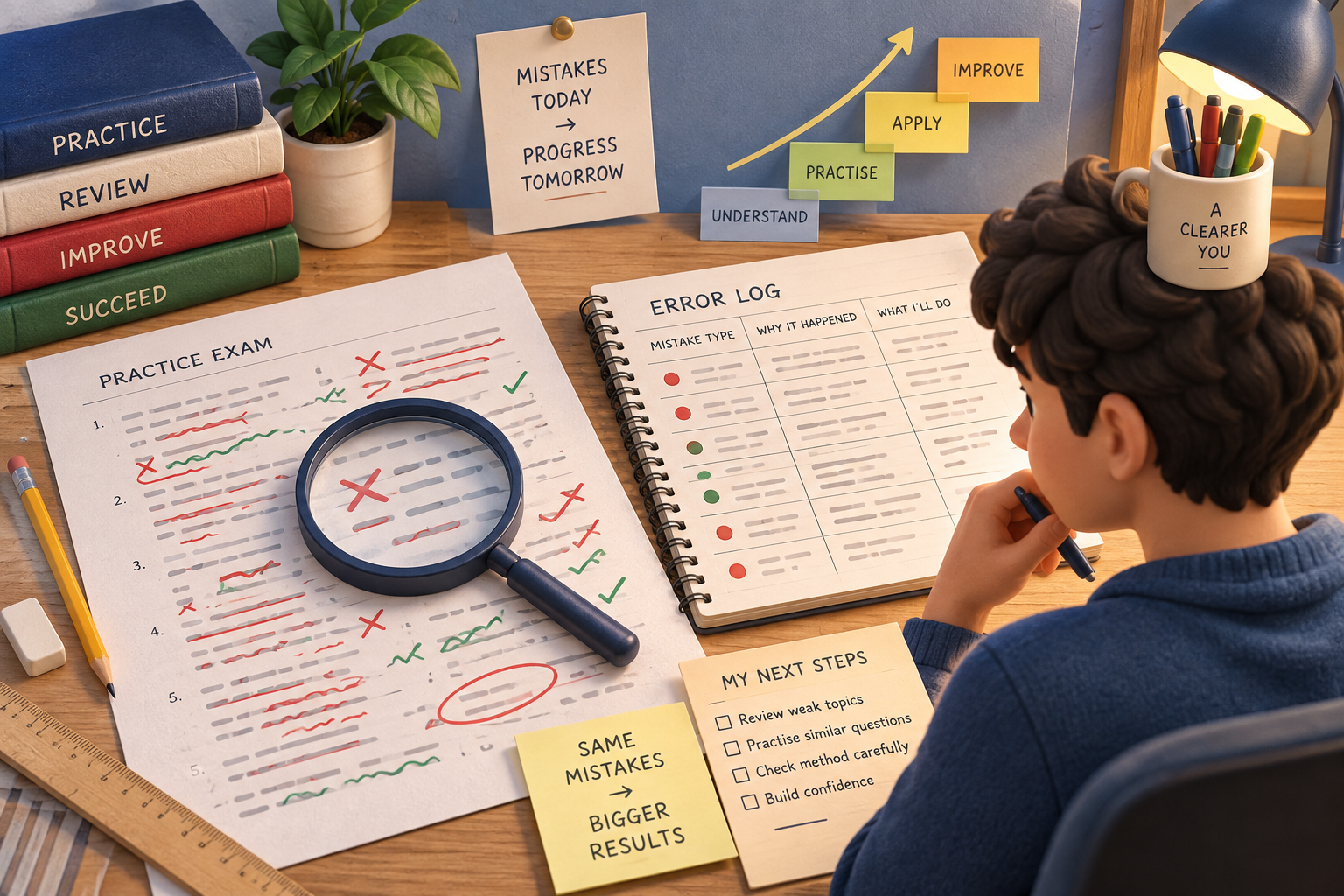
Turn a marked mock exam into a clear revision plan by sorting mistakes, finding patterns, and reattempting the questions that teach you the most.
A mock exam is not finished when you see the score. The marked paper shows how your knowledge, timing, reading, method, and answer style worked under pressure. If you only look at the number, you miss the useful information inside the mistakes.
A good review turns a paper into a short list of repairs. You do not need to rewrite every answer. You need to understand why marks were lost, fix the highest-impact problem, and test the repair later.
Why reviewing a mock exam matters
A practice paper gives you evidence from a situation that looks like the real exam. It can show that you forgot a topic, misunderstood a command word, rushed the last page, used the wrong formula, or failed to include enough evidence.
This evidence is more useful than a general feeling that you need to revise harder. It tells you what kind of revision to do next.
Do not only look at the score
Write the score down, but do not let it become the whole review. A score can hide a strong section, a repeated small error, or a question you nearly solved. Read the paper question by question.
For each question, ask what was the task, what did I write, what did the mark scheme reward, and why did my answer stop where it did? Keep your language factual. The goal is to find the repair, not insult yourself.
Make mistake categories
Use a few simple categories. Content means you did not know or recall the idea. Method means you chose the wrong process, formula, or structure. Reading means you misunderstood the question or missed a condition. Accuracy means a small error changed an otherwise correct answer.
Timing means you ran out of time or rushed. Communication means the answer was unclear, unsupported, or not matched to the command word. You can add a confidence category if you changed a correct answer without a good reason.
Separate knowledge and exam skills
A content gap needs learning and recall. An exam-skill gap needs question practice, timing, planning, or answer structure. The two can happen together, but they need different repairs.
If you knew the topic but used the wrong method, do not reread the whole chapter. Practise identifying the method in new questions. If you knew the method but forgot a formula, make a small recall task and use it in a problem.
Read the whole question again
Look at the command word, topic, number of marks, source, and conditions. Sometimes the answer is correct for a different question. Write what the question asked in plain language.
Check whether you answered every part. A question may ask for two reasons, a comparison, a calculation and an explanation, or a judgement with evidence. Missing one part can cost marks even when the rest is good.
Use the mark scheme carefully
The mark scheme is a guide to the required content and reasoning. It is not always a model answer you must copy word for word. Identify the point, evidence, step, or link that your answer needed.
If you do not understand why the mark was not awarded, ask a teacher or compare with a worked example. Do not simply highlight the correct answer and move on. Explain what your answer was missing.
Rewrite one answer at a time
Choose a question that teaches you something important. Close the mark scheme and rewrite the answer using the correction. Add the missing step, use the right command word, or structure the explanation more clearly.
Then compare again. Keep the correction short. You are practising the change, not producing a perfect essay for every question in the paper.
Find patterns across the paper
After reviewing individual questions, look for repeated problems. Did you lose marks whenever you had to explain why? Did calculations go wrong after unit conversion? Did the final page become rushed? Did you forget the same topic in several questions?
Patterns deserve priority because one repair can improve many future answers. A repeated command-word problem may be more valuable to fix than one rare fact.
Turn errors into repair tasks
Write each important error as an action. Instead of revise electricity, write practise choosing between the three electricity equations. Instead of improve essays, write plan two evaluation answers with a final judgement.
A repair task should have a finish line. Decide how many questions, minutes, or answers will show that you practised. Put the task in your study planner.
Reattempt questions after a gap
Do not reattempt while the correction is still in your head. Wait until later that day or another session. Cover your old answer and solve the question again without looking.
If you can now complete it, try a similar question with different wording. The goal is not to memorise one answer. It is to make the correction available when the problem changes.
Build a mock-exam error log
Keep a simple table with question, error category, missing idea, repair task, and recheck date. Add the paper name and topic if useful. Keep the log short by removing an issue after you have shown that the repair works more than once.
A study time tracker can help you see whether the same error keeps using your study time. If it does, ask whether the task is too broad or whether you need feedback from a teacher.
Use the next paper differently
Before the next mock, choose two behaviours to test. For example, underline command words, write a one-line plan before long answers, check units, or leave ten minutes for review. Do not try to change ten habits at once.
After the next paper, check whether the behaviour helped. Keep what works and change what does not. This turns each mock into an experiment rather than a judgement.
Common mock-exam review mistakes
Do not review only the wrong answers. A correct guess may need checking too. Do not spend the whole session copying model answers. Do not blame timing without checking where time went. Do not fix a small spelling error before a repeated method problem.
Avoid doing another full paper immediately if you have not repaired the main gaps. A short focused question set may teach you more.
Frequently asked questions about reviewing mocks
Should I review a mock exam immediately?
You can check the score and mark the main errors soon after, but a deeper review may be better after a short break. Review while you remember the attempt, but give yourself enough distance to think clearly.
What if I made mistakes in every section?
Look for patterns and choose the highest-impact repair. Start with one foundation or skill that affects many questions. Ask for help sorting priorities instead of trying to redo the whole course in one night.
How many questions should I redo?
Redo the questions that reveal repeated errors, important topics, or a method you need often. A few well-reviewed questions can be more useful than copying every wrong answer.
Related AcademyNC tools
Record patterns with the study time tracker, schedule repair tasks in the study planner, and use the study timer for focused correction blocks. An AI practice quiz can give you fresh questions on a weak method after you understand the original mistake.
Final thoughts
A mock exam becomes valuable when you learn from the attempt. Sort mistakes, read the question again, use the mark scheme to find the missing piece, and turn that piece into a small repair task.
Your next score is more likely to improve because of the quality of the review than because you simply completed another paper.




