
How to Revise Geography Case Studies for Exams
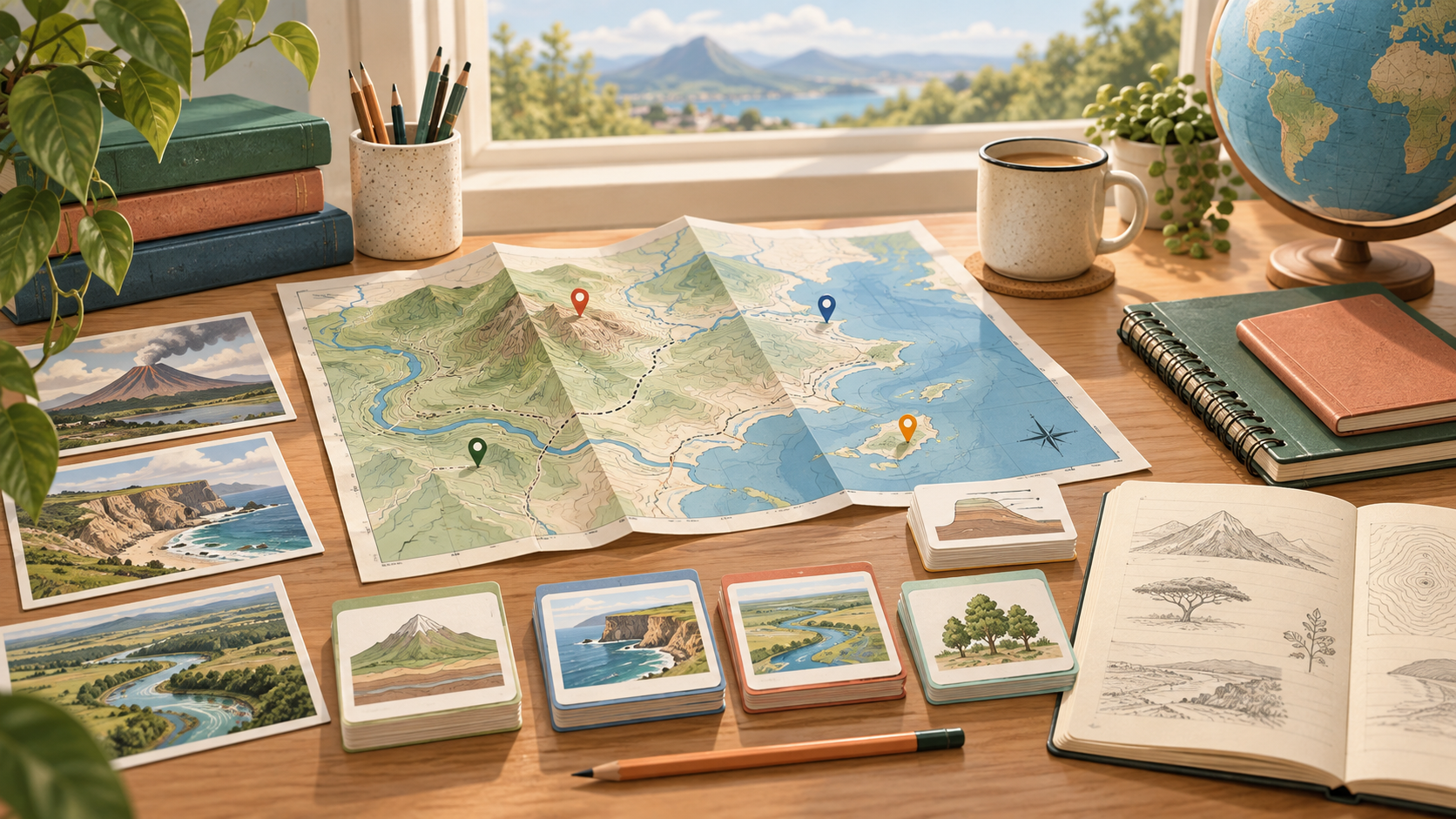
Learn how to revise geography case studies with a simple fact framework, active recall, maps, data practice, and exam-style answers that use evidence well.
Geography case studies can feel like a large pile of places, dates, statistics, causes, impacts, and management strategies. The problem is often not that the information is impossible. It is that students try to remember each case study as one long story. A better method is to reduce every example into a small set of useful facts, practise recalling them without notes, and then use the evidence in exam-style answers. This guide explains how to revise geography case studies in a way that is organised, flexible, and easier to remember.
Why geography case studies feel hard
A case study can be used in many different questions. One question may ask about causes, another about impacts, and another about the success of a response. If you memorise one fixed paragraph, you may know the story but still struggle to select the right evidence.
Geography also tests both knowledge and skills. You may need to explain a process, interpret a map, compare places, describe data, or evaluate a strategy. A good case study bank supports these skills, but it should not replace them.
The first step is to make the information smaller. Instead of trying to learn every sentence from a textbook, identify the facts that help you answer likely question types. A statistic is useful when you know what it shows and how to connect it to the question.
Start with the exam specification
Before making flashcards, find the list of case studies and examples required for your course. Different exam boards and schools may use different places. Online revision lists can be helpful, but your specification and teacher checklist should decide what you need.
Make one master list with four columns: topic, named place, question types, and confidence. For example, a coastal case study may be used for physical processes, impacts, management, or evaluation. Mark each case as secure, developing, or urgent.
This prevents a common mistake: spending hours learning a case study that is not needed while ignoring one that your course is likely to assess. It also shows you which examples can answer more than one type of question.
Reduce each case study to core facts
The goal is not to learn the maximum number of facts. The goal is to remember enough specific evidence to build a clear answer. Start with the location, time or event, key causes, main impacts, responses, and a judgement or limitation.
Keep the first version short. If you are revising an earthquake, you might record where it happened, why the area was vulnerable, two effects, two responses, and one reason the response was more or less successful. If you are revising urban change, record the location, population or economic context, one challenge, one opportunity, and evidence for a response.
Add facts only when they improve an explanation. A list of ten numbers is not automatically stronger than two accurate numbers used well.
Use the five-part case study frame
A simple frame for many geography case studies is location, causes or processes, impacts, responses, and judgement. The exact headings can change with the topic, but the frame helps you see the complete example.
Location tells the examiner which place you mean and gives context. Causes or processes explain what happened. Impacts show why it mattered. Responses describe what people, governments, businesses, or organisations did. Judgement explains how effective, fair, sustainable, or successful the response was.
Write each part in short prompts rather than full paragraphs. Then practise expanding one prompt into a sentence. This gives you flexible material for short, medium, and extended questions.
Learn location and context
Place-specific detail makes a geography answer more convincing. Learn the country, region, city, coastline, river, or development context that fits your case study. Use a simple map or a location card and test yourself without looking.
Context matters because the same event can have different effects in different places. A hazard in a wealthy city may lead to different damage and recovery than a similar hazard in a poorer rural area. A coastal management plan may be easier to fund in a high-value tourist area than in a low-income community.
Try explaining the case study in one sentence that includes the place and the main geographical idea. If you cannot do that, the case study may still be a collection of disconnected details.
Practise recall without notes
Rereading a case study can make it feel familiar without proving that you can remember it. Use a blank page instead. Write the case-study name, draw your five-part frame, and fill in as much as you can.
Check your notes in a different colour. Do not copy the entire correct answer. Mark the missing or inaccurate parts, then close the notes and try again later. This shows you exactly which section needs attention.
Space the attempts across several days. A short recall session after a gap is more useful than rewriting the same sheet three times in one evening. Mix older case studies with newer ones so you practise choosing the right example.
Turn facts into exam evidence
A fact becomes evidence when it supports a point. If you write a number, explain what the number shows. If you mention a response, explain who benefited, what problem it addressed, and what limitation remained.
Use a simple evidence sentence: point, specific fact, explanation, and link to the question. For example, state that a management strategy reduced erosion, give a named detail or measured result, explain the mechanism, and then say why that matters for the question.
Avoid dropping facts into an answer without a connection. The examiner needs to see why the detail is relevant. Practise taking one fact and writing three different links depending on the question wording.
Use maps photos graphs and data
Some geography questions include a map, photograph, graph, or table. Learn how to use these sources alongside your case study rather than treating them as separate skills. Start by reading the title, scale, units, key, and time period.
Describe the main pattern before explaining it. Mention a direction, difference, peak, fall, cluster, or anomaly and support it with data when possible. Do not make a cause claim if the source only shows a relationship.
For case study revision, collect one useful map, image, or graph for important examples. Ask what it shows and what it cannot prove. This helps you avoid making a statement that is stronger than the evidence.
Answer command words
Command words tell you what the answer must do. Describe usually needs an accurate account of what is shown or what happened. Explain needs a reason and a chain of effects. Compare needs a similarity or difference linked across two things. Assess or evaluate needs a judgement supported by evidence.
Underline the command word before writing. Then choose only the case study facts that help you meet that task. A long description will not answer an evaluate question, and a judgement without evidence will not be convincing.
Practise planning before writing. For a longer question, list the point, the case study evidence, the explanation, and the conclusion. A two-minute plan can stop you from using your best fact in the wrong paragraph.
Compare case studies
Comparison is easier when you use the same categories for both places. Compare location, scale, causes, vulnerability, impacts, responses, costs, and success. Do not simply write everything about case study A and then everything about case study B.
Make a two-column table, close your notes, and explain one similarity and one difference. Add a reason for the difference. For example, the response may differ because of income, governance, access, technology, population density, or the time available.
Use comparison questions as retrieval practice. They test whether you understand the geographical idea, not only whether you can remember a single story.
Review weak facts with spaced practice
Your revision planner should show when you will return to each case study. Revisit urgent examples sooner and secure examples after longer gaps. Keep the sessions short and active.
Use a study timer for a ten-minute fact recall, a fifteen-minute case-study plan, or a longer timed answer. Track which case studies you can recall completely and which still need support. Progress is clearer when you measure what you can produce without notes.
After marking a question, update your case-study sheet. Add only the correction that will help next time. Too much extra detail can make the sheet harder to use.
Avoid common revision mistakes
Do not memorise facts without knowing the topic they support. Do not use a statistic just because it looks impressive. Do not rely on a case study from a different course unless your teacher confirms it is acceptable. Do not revise only physical geography or only human geography.
Another mistake is ignoring the judgement. A case study is often used to assess whether a strategy worked, whether development was sustainable, or whether an impact was severe. Prepare at least one balanced conclusion for important examples.
Finally, do not wait until the night before an exam to test recall. A case study needs repeated retrieval so the details are available when the question is unfamiliar.
Frequently asked questions about geography case studies
How many facts should I learn for each case study?
There is no single number for every course. Aim for a compact set that covers location, causes or processes, impacts, responses, and a judgement. Learn a few accurate facts that you can explain rather than a huge list that you cannot apply.
How do I remember geography statistics?
Connect each statistic to a story or comparison. Record what it measures, the unit, the time period, and why it matters. Test yourself with the prompt “What does this number prove?” rather than only trying to repeat the number.
What if I forget a case study in the exam?
Stay calm and use the geographical knowledge you do remember. Give the location, a relevant process, a specific impact, or a reasonable response. After the exam, identify which part of the case study failed and add it to your next recall session.
Related AcademyNC tools
A study planner can spread case studies across the weeks before an exam. A study timer can help you complete short recall blocks and timed geography answers. An AI practice quiz can test location, causes, impacts, and evaluation. The study time tracker can show whether you are giving enough attention to case studies as well as general geography skills.
Final thoughts
Strong geography case study revision is about selection and application. Start with the specification, reduce each example to core facts, practise recalling it without notes, and connect every detail to the question. Use maps, data, command words, comparisons, and balanced judgements to turn memory into marks. You do not need to remember every sentence in a textbook. You need a small bank of accurate evidence that you can use flexibly when the exam asks something new.




