How to Stop Checking Your Phone While Studying
Use practical focus strategies to stop checking your phone while studying, reduce notifications, and protect your attention during study sessions.
You sit down to study, open your notes, and then reach for your phone without planning to. One message becomes a short video, a short video becomes scrolling, and suddenly the study block is nearly over. This does not mean you are lazy. Phones are designed to offer quick novelty whenever your attention has a quiet moment.
The answer is not always throwing the phone away forever. A more useful plan changes the environment, removes easy cues, sets clear checking times, and gives your attention a realistic period to settle. You can learn how to study without constant phone interruptions one block at a time.
Why your phone keeps pulling your attention
Every notification creates a possible reason to look. Even without a sound, the phone may remind you of messages, social apps, news, games, or unfinished tasks. Checking can also become a habit loop: you feel bored or uncertain, reach for the phone, and receive a quick reward.
The first goal is to notice the loop without insulting yourself. The moment before you check is useful information. Were you stuck on a hard question? Did the task feel unclear? Were you tired? Different triggers need different solutions, so start by observing what happens during your study blocks.
Find your personal checking triggers
For three sessions, write down each unplanned phone check. Record the time, what you were doing, and how you felt. You may discover that you check when a timer ends, when you need a formula, after a difficult paragraph, or whenever a notification lights the screen.
Do not try to fix everything at once. Choose the most common trigger. If notifications start the problem, silence them. If difficult questions start it, keep a help note beside you and mark the question for later. If boredom starts it, use shorter blocks with a clear finish line.
Remove the easiest cues
Turn off non-essential notifications before you study. Remove social apps from the first screen, log out of accounts you open automatically, and use a setting that stops the display from lighting up. These small changes reduce the number of decisions you need to make.
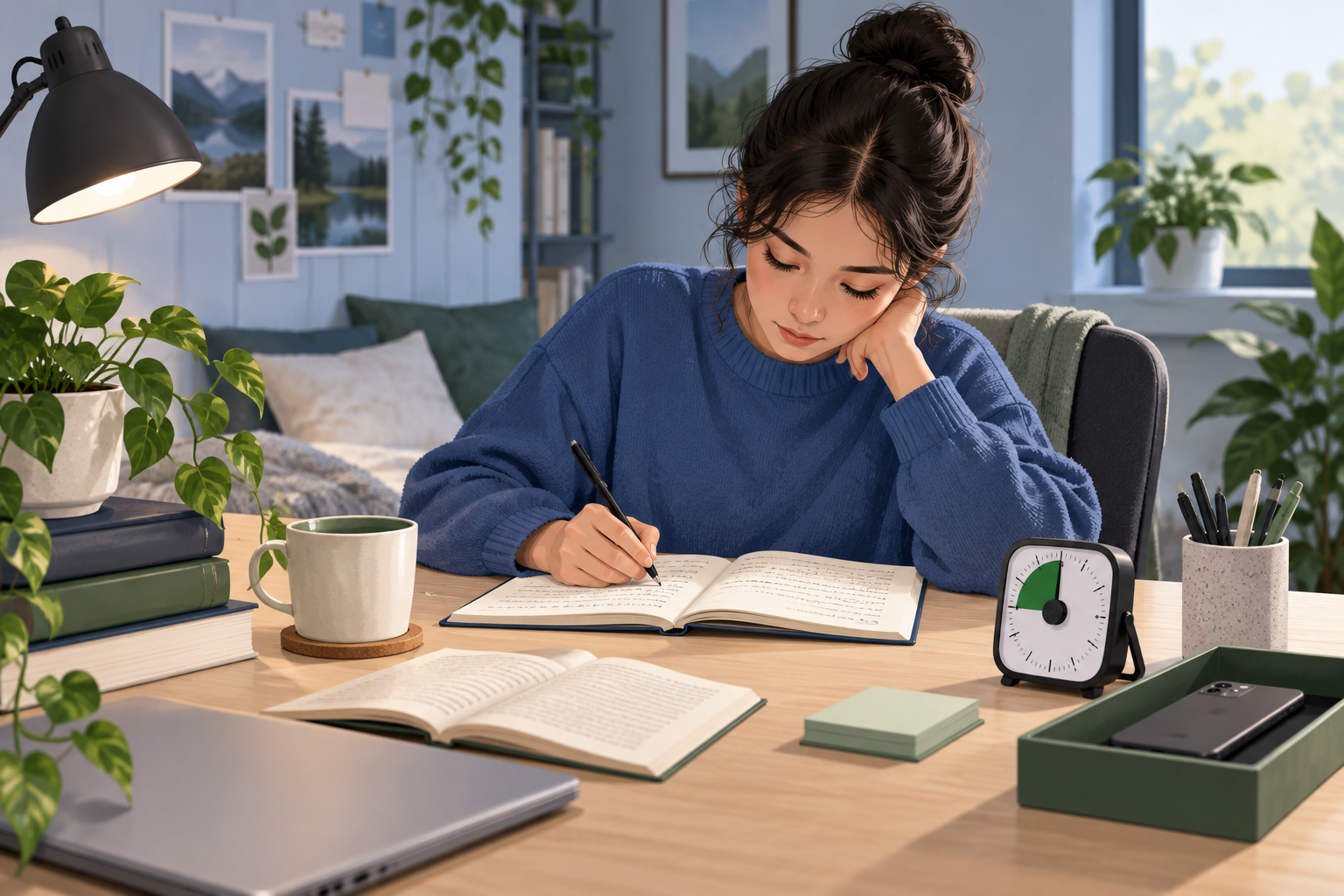
Do not rely only on willpower while keeping the phone beside your hand. If the phone is within reach, every check is easy. Put it in a bag, drawer, or another room. Add enough distance that checking requires a deliberate choice rather than a reflex.
Create a phone-free study block
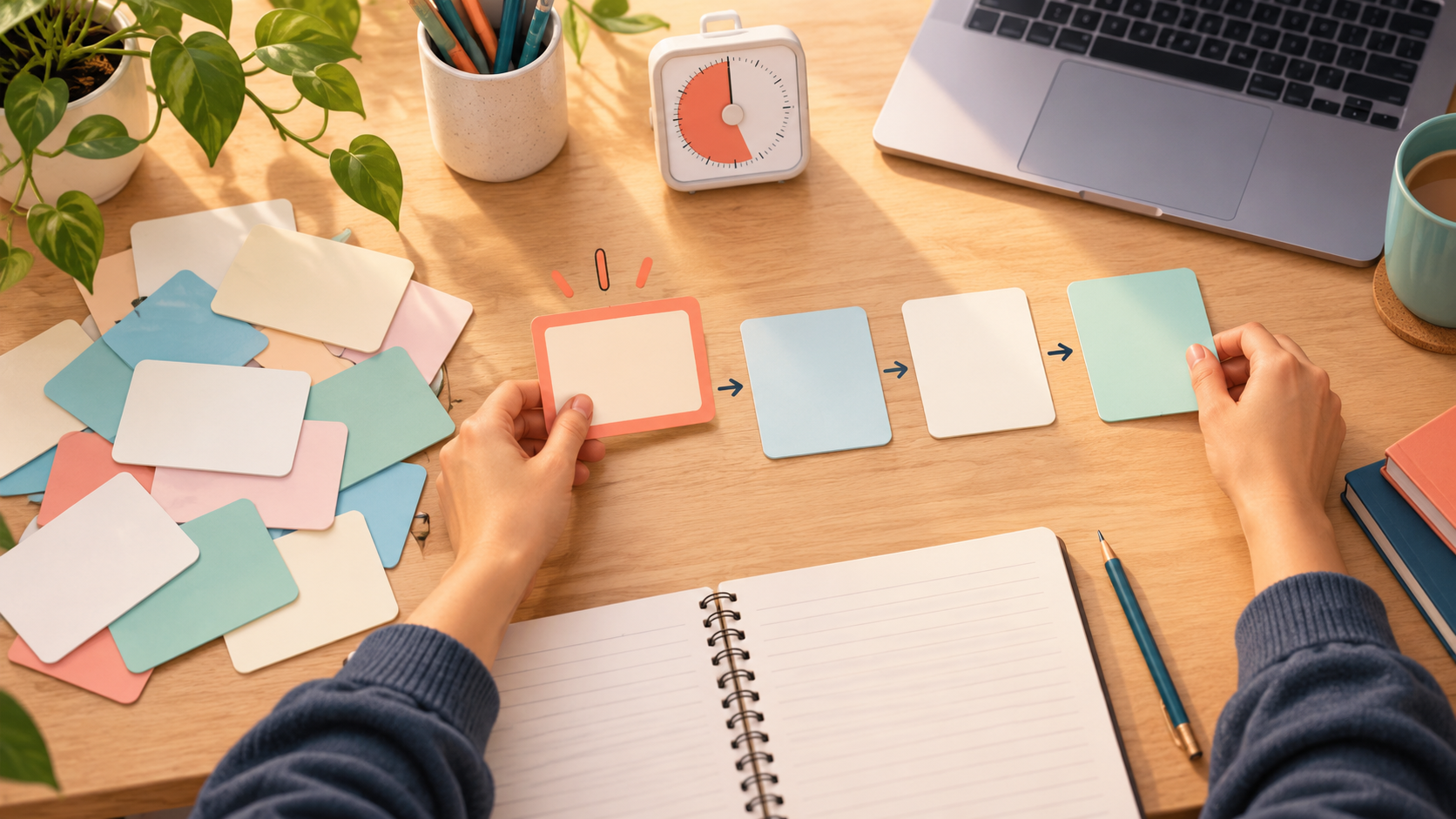
Choose one block and define the rule before it starts. For the next 25 minutes, the phone stays away unless there is a genuine safety or family reason. Write down the task, start the timer, and begin. A clear rule is easier to follow than the vague promise to use the phone less.
Start with a block that is likely to succeed. If you are used to checking every few minutes, ten phone-free minutes is a reasonable beginning. Add five or ten minutes after the first version feels normal. The goal is to train your attention, not create a dramatic challenge that ends in frustration.
Use focus mode and notifications wisely
Most phones have a focus, do-not-disturb, or app-limit setting. Use it to block the apps that interrupt you most. Allow emergency contacts if needed and tell family members when you will check messages. A setting works best when it supports a rule you have already chosen.
Be careful with study apps that turn into browsing. If you need a calculator, flashcard app, or timer, open only that tool and keep the rest blocked. When possible, use a physical timer or a timer on your computer so the phone does not become part of the distraction.
Put the phone farther away
Distance matters because an urge becomes weaker when the next step is inconvenient. Put the phone across the room, outside the study space, or with a trusted person for the block. If you use headphones, check that you are not also opening messages every time you change music.
Make the replacement location predictable. The phone goes in the same drawer before every study block and returns only during a planned check. A repeated parking place becomes a cue that the next few minutes belong to the work in front of you.
Plan when you will check messages
A phone-free block is easier when you know when you can check next. Use a five-minute break after a focused block, or set two message windows during a longer study period. Tell friends that you may reply later. Most messages do not require an instant answer.
Keep the check bounded. Stand up, read important messages, reply only when needed, and put the phone away before the next block. If your break becomes a long scroll, change the break activity to water, movement, or a snack and move social media to a separate time.
Replace the urge with a small action
When you reach for the phone, pause and take one breath. Write the thought on paper, such as check message or look up this fact. Then return to the question for two more minutes. Often the urge falls when you do not obey it immediately.
If you are genuinely stuck, use a planned alternative. Mark the question, write what you know, and continue to the next part. Keep a small parking-lot list for searches or tasks that can wait. This stops a study problem from becoming an excuse to open unrelated apps.
Protect your laptop from distractions
Moving the phone away helps, but a laptop can create the same problem. Close extra tabs, sign out of social sites, and use a separate browser profile for school work if that helps. Keep only the document, calculator, reference, or question set needed for the current task.
Write down links or questions you want to explore later. Curiosity is useful, but not every interesting thought belongs inside the current study block. Returning to your list after the timer ends gives the thought a place without letting it steal your attention.
Study around social pressure
Friends may expect quick replies because they see you online. Explain your study window in a short message before you start. You do not need to give a long reason. A simple line that says you will reply after the block creates a clear expectation.
If a group chat is important for a project, choose one person to contact for urgent updates and mute the rest temporarily. You can be available at planned times without being continuously available. Protecting attention is not the same as ignoring people.
Handle emergencies and important calls
Some students need to keep a phone nearby for family, health, work, or travel reasons. Make a plan that separates important calls from normal notifications. Allow the correct contacts, use a ringtone that you will hear, and keep the rest silent.
Tell the people who may need you when your next check will be. If you are worried, use a shorter block and check at the planned end. A realistic safety plan is better than a strict rule that makes you anxious and impossible to follow.
Track what actually improves focus
Use a study time tracker or a simple note to record the length of the block, number of checks, and what you completed. Compare phone-in-room, phone-away, and focus-mode sessions. Evidence makes the choice personal instead of turning it into a debate about willpower.
You may find that distance works better than app limits, or that morning blocks are easier than late-night work. Keep the strategy that improves useful output. The purpose of tracking is to learn your conditions, not to create another number to worry about.
Recover after a distracted session
If you lose half an hour to your phone, stop the spiral quickly. Put the phone away, choose the smallest next task, and start a short timer. Do not spend the rest of the day criticising yourself or trying to recover every lost minute at once.
After the session, ask what triggered the first check. Change one part of the setup before the next block. A mistake becomes useful when it teaches you where the system needs support. You are building a routine, not proving that you will never be distracted again.
Build a longer attention span
Attention grows through gradual practice. Use short focused blocks, active questions, and real breaks. When your mind wanders, return without drama. Each return is part of the training. Over time, increase the block length by a few minutes if the work remains accurate.
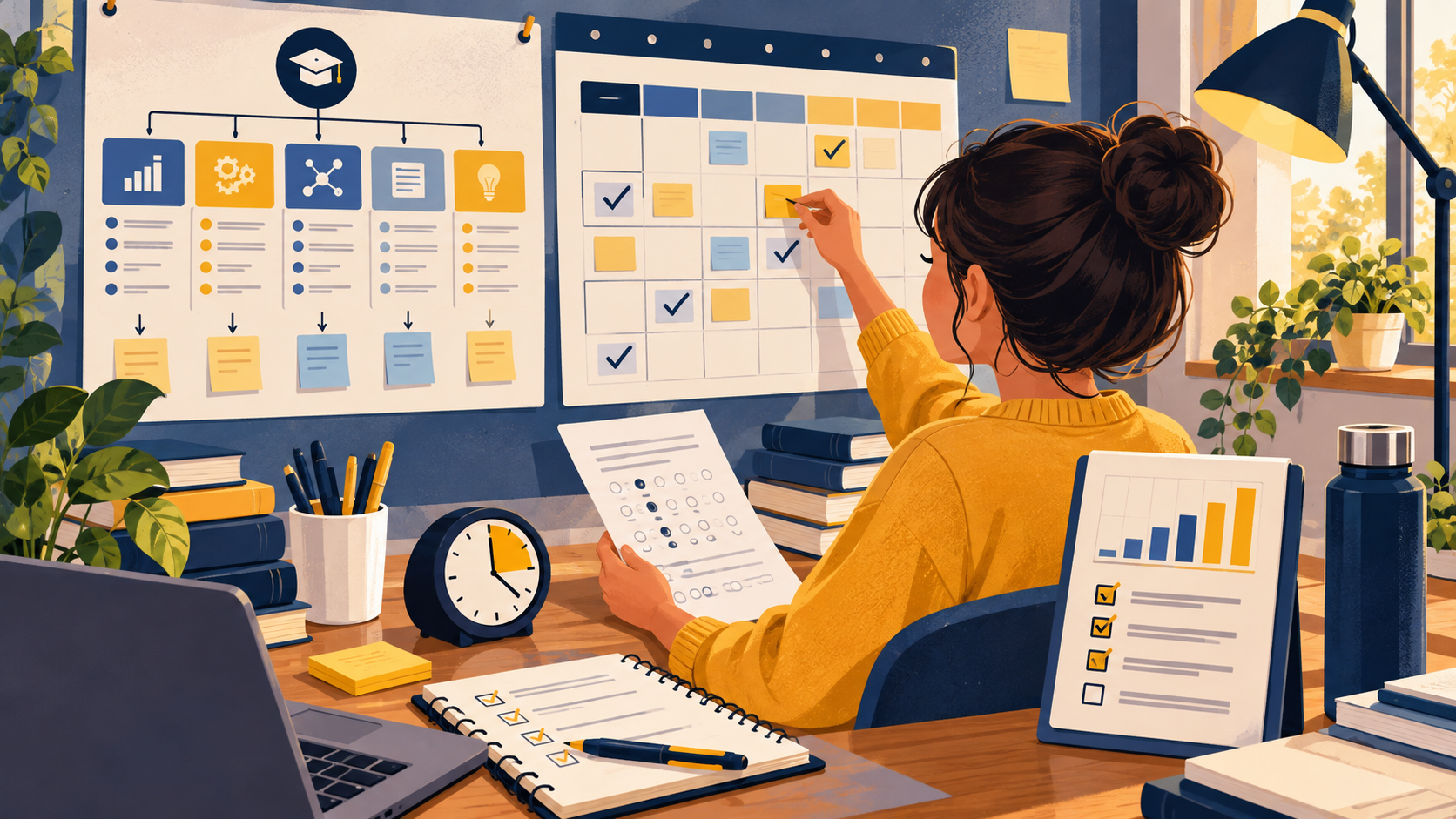
Use a study timer to give the work a visible boundary, and use the study planner to choose a task that can fit inside it. Starting with a clear finish line makes it easier to stay because you know what you are trying to complete.
Phone distraction questions students ask
Should I keep my phone in another room?
If you can do so safely, distance is one of the simplest ways to reduce checking. Start with the phone across the room or inside a bag. If you need it nearby, use focus mode, allow essential contacts, and create a clear checking time instead of leaving the screen available for every interruption.
What if I need my phone for studying?
Use one tool at a time. Open the timer, calculator, dictionary, or approved study app, then block unrelated notifications and apps. A physical timer or laptop tool may be better when the phone keeps pulling you into other activities. Keep searches on a parking-lot list for later.
How long does it take to improve focus?
You can notice a difference in a few sessions, but a stronger habit develops through repeated practice. Start with a short phone-free block, review what triggered checks, and increase gradually. Progress means returning to the task more quickly, not never having an urge to look.
Related AcademyNC tools
Use the study timer for phone-free blocks, the study planner to place those blocks at realistic times, and the study time tracker to compare different focus setups. An AI practice quiz can keep the study task active when passive reading makes distraction more likely.
Final thoughts
Stopping phone checks is easier when you change the environment instead of arguing with yourself every minute. Notice your triggers, remove easy cues, park the phone, plan message times, and practise short focused blocks. Your attention does not need to be perfect. It needs a clear place to return.