
How to Study for a Biology Exam: A Simple Active-Recall Plan
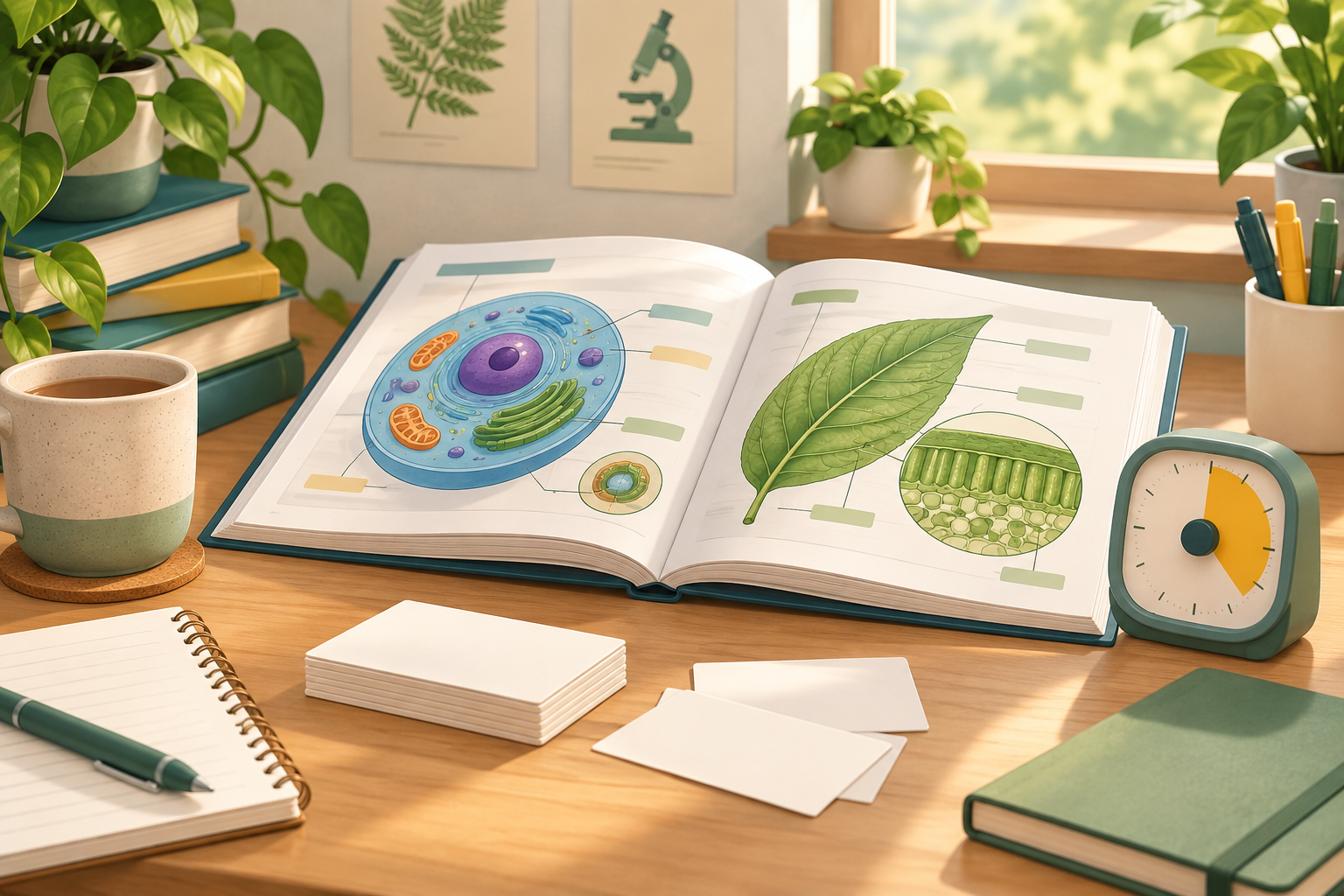
Learn how to study for a biology exam with active recall, blank diagrams, concept maps, practice questions, and a simple review plan that makes biology easier to remember.
Biology can feel like a pile of hard words, tiny diagrams, and processes that all look the same after a long day. The good news is that you do not need to reread every page ten times. You need a clear picture of how the ideas connect, and you need to practise bringing those ideas back from memory.
This guide shows you how to study for a biology exam without turning every evening into a panic session. You will learn a simple active-recall plan, a better way to practise diagrams, and a review routine that helps you notice weak spots early.
What Biology Exams Usually Test
Before you open your notes, think about the kind of work your teacher will ask you to do. Most biology exams mix four types of questions:
- Remembering key terms, parts, and definitions.
- Describing a process in the correct order.
- Reading or labelling a diagram, graph, or table.
- Applying an idea to a new example or explaining why something happens.
This matters because each type needs a slightly different kind of practice. A flashcard can help you remember the definition of osmosis, but it cannot fully prepare you to explain what happens to a cell in a new solution. A labelled diagram can help you see the parts of a heart, but you also need to explain how blood moves through them.
Step 1: Map the Exam Before You Study
Start with your syllabus, revision sheet, or the list of chapters your teacher gave you. Make a quick table with three columns: topic, what I can explain, and what I need to practise. Do not worry about making it pretty. The point is to turn a large course into smaller jobs.
Mark each topic with a simple colour or letter. Green means you can explain it without looking. Yellow means you recognise it but cannot explain it clearly. Red means it feels new or confusing. Study the red and yellow topics first. Spending another hour on a green topic feels comfortable, but it usually gives you less progress.
Also check the exam format. Will there be multiple-choice questions, short answers, diagrams, or lab questions? Your revision should look a little like the real exam. If the test asks you to compare mitosis and meiosis, practise comparison. If it asks you to label a cell, practise with a blank diagram.
Step 2: Learn the Big Picture First
Biology becomes easier when you see the system before memorising its parts. Read the headings in a chapter and ask, What is this topic trying to explain? For example, a chapter on respiration is not only a list of chemical names. It is about how cells release usable energy from food.
Use a one-page concept map
Write the main idea in the centre of a page. Add branches for the important parts, then connect each part with a short phrase. A good connection might say requires, produces, carries, breaks down, or happens in. Keep the words short. Your map is a set of handles for your memory, not a second textbook.
For a cell biology topic, you might connect cell membrane to controls movement, mitochondria to releases energy, and ribosomes to build proteins. Then close your notes and explain the whole map out loud. If you cannot explain why two ideas are connected, that is a useful gap to fix.
Step 3: Use Active Recall, Not Just Rereading
Rereading feels smooth because the information is in front of you. That feeling can be misleading. Active recall means looking away from the notes and trying to produce the answer yourself. The small struggle is exactly what strengthens the memory.
A simple recall routine
Read one small section, then close the book. On a blank page, write everything you remember. It can be messy. Next, open your notes and use a different colour to add what you missed. Finally, close the notes again and give the answer a second try.
You can use questions instead of notes:
- What is the job of this structure?
- What starts this process?
- What happens next, and why?
- What would change if one part stopped working?
- How is this idea different from the similar idea in the next chapter?
Make the questions yourself when possible. A question you wrote after getting confused is often more useful than a large deck of copied definitions.
Step 4: Draw Biology Diagrams From Memory
Diagrams are worth practising because they combine memory with understanding. Do not only stare at a perfect picture. Look at it briefly, cover it, and draw the basic shape from memory. Add the labels, then check your work.
Start with the few parts that matter most. Once you can draw those, add smaller details. For a heart diagram, practise the chambers, major vessels, and direction of blood flow before worrying about artistic accuracy. For a cell, practise the organelles and their jobs. A simple drawing that you understand is better than a beautiful drawing you copied.
Use arrows to show movement. Then explain the diagram as if you were teaching a younger student. If your explanation jumps from one label to another without showing the connection, practise the process again.
Step 5: Explain Processes in Simple Words
A process is easier to remember when it becomes a short story with a beginning, middle, and result. Try this pattern: where does it happen, what goes in, what changes, and what comes out?
Example: photosynthesis
Instead of memorising one long sentence, say it like this: a plant uses light energy to help turn water and carbon dioxide into glucose, and oxygen is released. Then add the place where it happens and the role of chlorophyll. Test yourself by asking what would happen if there were less light or less carbon dioxide.
Example: cellular respiration
Start with the purpose: the cell breaks down glucose to release usable energy. Then learn the main stages, where they happen, and what each stage produces. You do not need to force every detail into one sitting. Learn the road map first, then add detail through questions.
Use the same approach for DNA replication, protein synthesis, immunity, digestion, or any other multi-step topic. If you can explain the process in plain language, the technical terms have somewhere to attach.
Step 6: Practise Questions the Right Way
Once you understand the main ideas, move to questions. Do not wait until the night before. Practice questions show you what your brain can actually retrieve, and they often reveal small gaps that your notes hide.
Use three kinds of questions. First, answer direct content questions such as, What is the function of the Golgi apparatus? Second, answer diagram questions, such as, Label the path of blood through the heart. Third, answer what-if questions, such as, What might happen to a plant if its stomata stayed closed for a long time?
After every answer, ask yourself why it is correct. If you guessed, mark it as uncertain even when you got it right. A lucky answer is not the same as knowledge you can trust.
When you miss a question, do not just read the correct answer and move on. Write one short reason for the mistake. Maybe you confused two similar terms, forgot the order of a process, missed a word in the question, or never learned the idea in the first place. Each reason points to a different fix.
Step 7: Keep an Error Log
An error log can be a page in your notebook or a simple digital table. Add four things: the question or topic, your wrong answer, the correct idea, and what you will do next. For example, if you mixed up arteries and veins, your next action might be to draw the blood-flow diagram from memory twice.
Review this log every few days. It is one of the fastest ways to make your study time more personal. You are no longer doing random revision. You are working on the mistakes that are most likely to cost marks.
A 7-Day Biology Exam Study Plan
If you have one week, use this simple plan. Adjust the number of hours to your timetable and energy. A focused 45-minute session is more useful than three hours of half-reading while your phone keeps interrupting you.
Day 7: List every examinable topic. Make your red, yellow, and green map. Spend one session learning the big picture of the red topics.
Day 6: Study the first group of red topics. Make one-page concept maps and explain each map without notes.
Day 5: Study the second group of red topics. Draw important diagrams from memory and check the labels.
Day 4: Review yellow topics with active recall. Use short questions and compare ideas that are easy to confuse.
Day 3: Complete a mixed practice set. Add every uncertain or wrong answer to your error log.
Day 2: Fix the error log. Redraw weak diagrams, explain weak processes, and do another shorter practice set.
Day 1: Do a light review of key terms, maps, and diagrams. Stop studying at a sensible time so you can sleep.
You can run each block with an AcademyNC study timer. Set a clear task before the timer starts, work until the block ends, and take a real break. The timer is there to protect your attention, not to pressure you into studying for hours without stopping.
How to Study Biology the Night Before
The night before an exam is for organising what you already know, not trying to learn an entire course from zero. Review your error log, key diagrams, and the parts of your concept maps that still feel unclear. Try a small set of questions, but do not keep doing new papers until midnight.
Pack what you need, check the exam time, and get enough sleep. Memory depends on rest. If you stay awake for extra hours but cannot think clearly in the morning, those hours did not help as much as they seemed to.
Common Biology Study Mistakes
Only highlighting: Highlighting can help you find important lines, but it does not prove that you can recall them. Follow it with a closed-book explanation.
Memorising words without meaning: Definitions matter, but attach every term to a job, example, process, or diagram.
Copying diagrams: A copied diagram tests your hand more than your memory. Draw it after covering the example.
Ignoring similar ideas: Biology has many pairs that sound alike. Make small compare tables for terms such as diffusion and osmosis, mitosis and meiosis, or arteries and veins.
Doing questions without reviewing them: The learning is often in the review. Find the reason behind each wrong or uncertain answer.
Studying only your favourite chapter: Begin with the topics that are difficult and important. Save the easy review for later.
Biology Exam FAQ
How many hours should I study for a biology exam?
There is no useful number for everyone. Start with the topics and tasks you need to finish, then divide them across the days you have. For many students, two or three focused blocks are enough on a normal school day when the work is active. More hours are not automatically better if you are only rereading.
Should I make biology flashcards?
Yes, but keep them focused. Use flashcards for terms, functions, short comparisons, and steps you often forget. Add a question on the front and answer it from memory before turning the card over. Do not copy a whole textbook paragraph onto one card.
What if I cannot remember biology diagrams?
Break the diagram into layers. First remember the main shape, then the large parts, then the labels, then the direction of movement. Draw it from memory several times across different days. Add a short explanation of what each part does.
Is memorising enough for biology?
Memorising is part of biology, but it is not the whole job. You also need to explain relationships, follow processes, read diagrams, and apply ideas to new situations. Active recall and practice questions train those skills together.
What should I do if a chapter still makes no sense?
Shrink the problem. Write the one sentence you do understand, circle the exact step that breaks your understanding, and ask a teacher, classmate, or reliable resource about that step. A specific question is much easier to answer than, I do not understand the whole chapter.
Final Checklist
Before the exam, you should be able to do these things without looking at your notes:
- Explain the main idea of every examinable topic.
- Define the important terms and give a simple example.
- Draw and label the key diagrams.
- Describe major processes in the right order.
- Answer mixed practice questions and explain your mistakes.
- Tell the difference between topics that are easy to confuse.
The best biology study plan is not the one with the most colours or the longest hours. It is the one that makes you retrieve information, explain it, use it, and return to it after a gap. Start with the hardest topic today, set a small timer, and make your first closed-book attempt. You will know much more about what to do next after that one honest try.
For a simple study routine, use AcademyNC's study timer to split revision into focused sessions, the study planner to organise topics across the week, and the study tracker to see which chapters you have actually practised. Small, repeatable sessions add up quickly when each one has a clear job.




