
How to Study for Multiple Exams at Once: A Simple Plan
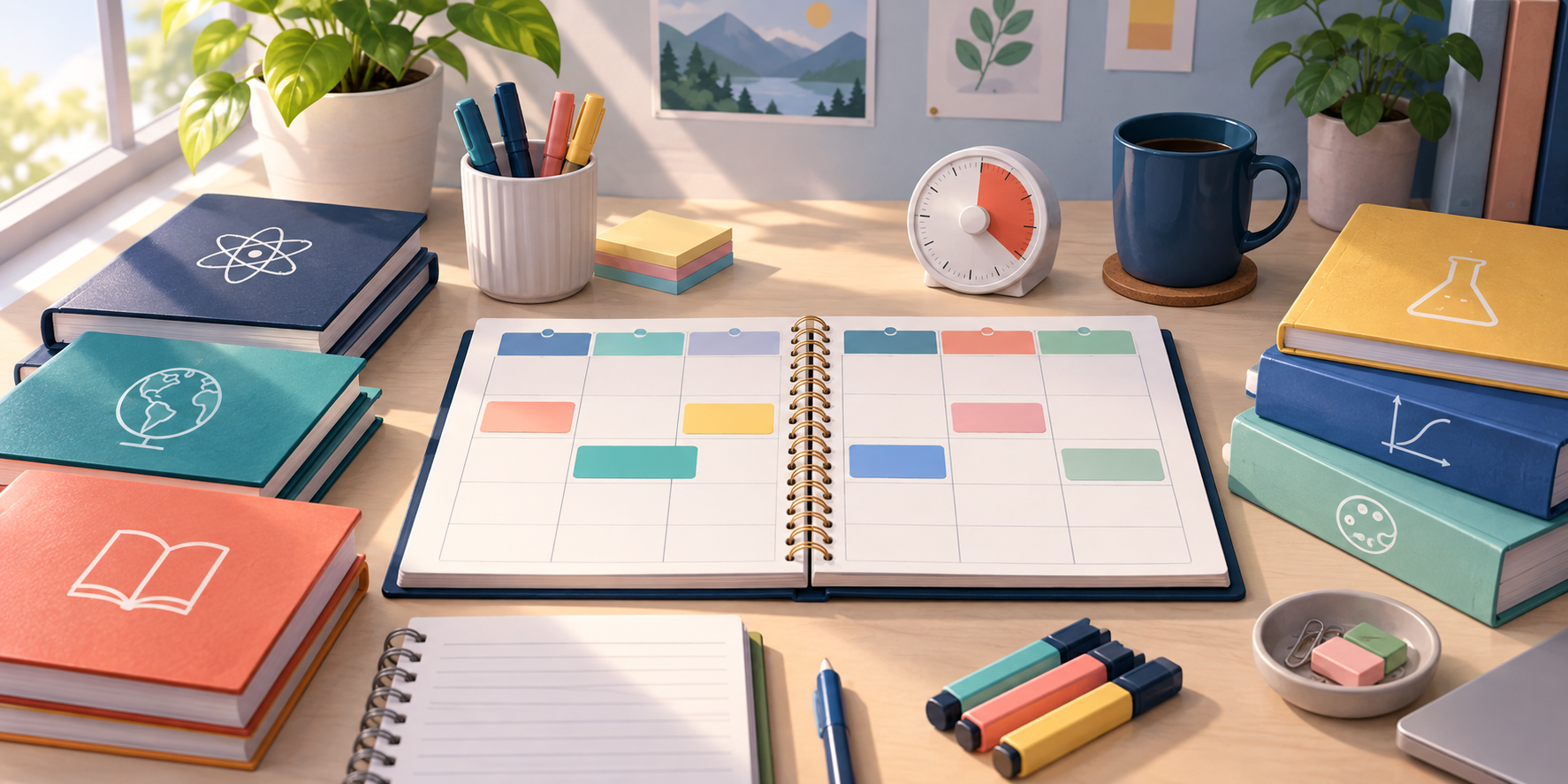
Learn how to study for multiple exams at once with a realistic timetable, smart priorities, focused sessions, and simple ways to keep moving when deadlines overlap.
Studying for one exam can feel demanding. Studying for several exams at once can make every subject seem urgent, even when it is not. You may open your books, worry about the next deadline, and then lose the whole session deciding what to do first. A clear plan changes that. You do not need to study every subject every day, and you do not need a perfect timetable. You need a simple system that shows what matters, gives each subject a place, and helps you practise before the exam arrives. This guide explains how to study for multiple exams at once without turning your week into an impossible list of tasks.
Why multiple exams feel overwhelming
The main problem is not always the amount of work. It is the number of decisions you have to make. Every subject has different topics, different levels of difficulty, and a different exam date. If you keep all of that in your head, revision feels like one large emergency.
Multiple exams also create a false choice. You may feel that working on one subject means neglecting another. In reality, a good plan spreads attention across the week and gives extra time to the subjects that need it most. The goal is not equal hours for every subject. The goal is enough useful practice for each exam.
Start by replacing vague thoughts such as “I need to revise biology” with clear actions such as “complete ten questions on cell transport and mark them.” A specific task is easier to start and easier to finish.
List every exam and its real demands
Write down each exam date, subject, paper, and major topic. Add the format too. A multiple-choice paper, an essay paper, a calculation paper, and a practical paper all need different preparation. Do not assume that one generic revision method will work for everything.
Next to each subject, record what you already know and what still feels weak. You can use three labels: secure, developing, and urgent. Secure topics need occasional testing. Developing topics need regular practice. Urgent topics need attention soon because you do not yet understand the basics or cannot answer questions without help.
Break large subjects into small units. “History” is too broad for a timetable. “Causes of the 1917 Revolution” is a usable unit. “Chemistry” is too broad. “Moles and concentration calculations” is much clearer. Smaller units make your plan honest and stop you from counting passive reading as completed revision.
Set priorities without ignoring smaller subjects
Priorities should come from three things: how soon the exam is, how important the topic is, and how confident you feel. A subject with an exam next week and several weak topics deserves more time than a subject you understand well and will sit next month.
A simple scoring method can help. Give each subject a deadline score from one to three, a difficulty score from one to three, and a confidence score from one to three where a low confidence score means you need more help. Add the scores. The highest totals are your first priorities.
This is not a scientific measurement. It is a way to make your choices visible. Review the scores every few days because your priorities will change as exams get closer and your understanding improves.
Work backwards from each exam date
Start with the exam date and work backwards. Mark the final day for light review, the day before that for a timed paper, and earlier days for learning and mixed practice. Leave a small buffer for illness, travel, homework, or a session that takes longer than expected.
Think in phases. In the first phase, learn or repair the basics. In the second phase, practise individual topics. In the third phase, complete mixed questions and timed papers. In the final phase, review mistakes, definitions, formulas, and common traps.
Do not place your biggest study load on the last two days. Last-minute work can be useful for a short review, but it cannot replace the repeated practice that makes knowledge easier to recall.
Build a weekly study map
Create a weekly map before filling in exact times. Decide how many useful sessions you can complete on normal school or college days and how many you can complete at the weekend. Be realistic. A plan that expects eight perfect hours after a full day of classes will usually fail by Tuesday.
Give each subject a minimum number of sessions. Then add extra sessions to the highest-priority subjects. For example, you might plan three mathematics sessions, two biology sessions, two English sessions, and one short review for a subject that is already secure. This gives every subject a place without pretending every subject needs equal time.
Use your study planner to see the whole week at a glance. Keep one or two open blocks for catch-up. Empty space is not wasted time; it is what keeps one missed session from breaking the whole plan.
Use focused blocks instead of vague study time
A study block should have a start point, a finish point, and one clear outcome. You could spend 30 minutes learning a topic, 25 minutes answering questions, and 10 minutes marking and correcting them. The exact length matters less than the focus.
A study timer can make the start easier. Work for a chosen period, take a short break, and then stop when the block ends. During the block, keep your phone away and write down distracting thoughts instead of following them. If you finish early, use the remaining time to test yourself rather than opening social media.
Choose shorter blocks when you are tired and longer blocks when you are doing a full practice paper. The best length is the one that lets you work carefully and return tomorrow.
Balance subjects across the week
Avoid putting the same demanding subject into every session. Switching between subjects can help you stay alert and can improve your ability to choose the right method. You might do a calculation subject in the morning, a reading-heavy subject later, and a short recall review in the evening.
Spacing matters more than a single huge session. Two 40-minute sessions on different days are usually more useful than one long session followed by six days of forgetting. Return to important topics after a gap so your brain has to retrieve them again.
Try not to schedule three new topics back to back. Pair a difficult learning session with a practice session or a subject you find more comfortable. This keeps the week challenging without making every block feel heavy.
Choose the right task for each subject
Use the task that matches the problem. If you cannot explain a concept, read a short section, close the book, and explain it in your own words. If you understand the idea but cannot answer questions, do exam practice. If you make the same error repeatedly, study the mistake and write a rule that would prevent it next time.
For essay subjects, practise plans, introductions, evidence, and timed paragraphs. For science and mathematics, mix worked examples with questions that require you to choose the method. For languages, use retrieval for vocabulary and short writing or speaking practice. For factual subjects, use questions instead of highlighting whole pages.
Your revision task should produce evidence. At the end of a session, you should have answers, a plan, a corrected problem, a spoken explanation, or a short summary from memory.
Use practice tests to measure progress
Practice tests show whether information is available when you need it. Start with topic questions while learning, then move to mixed sets that make you choose between methods. Mark the work carefully and sort errors into knowledge gaps, careless mistakes, misunderstood questions, and timing problems.
Keep a short error log. Write the question type, what went wrong, and what you will do differently. Revisit the log every few days. Your weakest area is often not the topic with the lowest score; it may be the mistake that appears again and again.
Use your results to update your plan. If a topic becomes secure, reduce its frequency but keep a short review. If a topic stays weak after several attempts, change the approach. Ask for help, use a different explanation, or practise easier questions before returning to the exam level.
Protect sleep and recovery
Sleep is part of revision because tired brains learn and recall less reliably. Try to keep a regular sleep window, especially during the week before an exam. A late-night session may feel productive, but losing sleep can make the next day slower and less focused.
Take real breaks. Stand up, drink water, eat something useful, or walk for a few minutes. Breaks are not a reward you have to earn by suffering. They help you return with attention.
Keep one small part of the day free from exam work. This could be exercise, music, a conversation, or time outside. The purpose is not to escape your responsibilities. It is to make the schedule sustainable.
Fix the plan when you fall behind
Falling behind does not mean the plan is useless. It means the plan needs a smaller next step. Do not try to fit every missed task into one evening. Look at the upcoming exams, keep the most important tasks, and move lower-priority work to a later open block.
Use a reset session. Spend ten minutes listing what is unfinished, five minutes choosing the next task, and then complete one focused block. After that block, decide again. Action reduces the worry that often grows while you are only planning.
If the workload is genuinely too large, ask a teacher, tutor, parent, or classmate for help deciding what to prioritise. Good planning includes asking for support before the pressure becomes unmanageable.
Frequently asked questions about studying for multiple exams
How many subjects should I study in one day?
Most students do well with two or three subjects in a day, depending on the length of each session. One main subject and one lighter subject can be enough on a busy day. More variety is useful when you have a long study day, but changing subjects too often can waste time.
What if two exams are close together?
Give both subjects regular attention, then use the closest exam to set the daily priority. Keep a short maintenance session for the other subject so it does not disappear from memory. After the first exam, move that time to the next paper.
How do I catch up after missing a study session?
Do not punish yourself with an extreme timetable. Identify the missed outcome, choose the smallest useful version of it, and place it in an open block. Then continue with the current plan. Consistency after a missed session matters more than trying to create a perfect week.
Related AcademyNC tools
A study planner can help you place subjects, deadlines, and catch-up blocks across the week. A study timer can turn each plan into a focused session. The study time tracker helps you see whether your actual work matches your intentions. When you need extra practice, an AI practice quiz can turn a topic into questions that test what you remember.
Final thoughts
Learning how to study for multiple exams at once is mostly about reducing confusion. List the exams, break subjects into real tasks, work backwards from the dates, and practise in focused blocks. Give more time to urgent weaknesses, but keep every subject moving. Review mistakes, protect sleep, and adjust the plan when life changes. You do not need to control every hour. You only need a clear next step and a timetable you can follow more often than not.




