
How to Study Geography Effectively: Maps, Case Studies, and Exam Questions
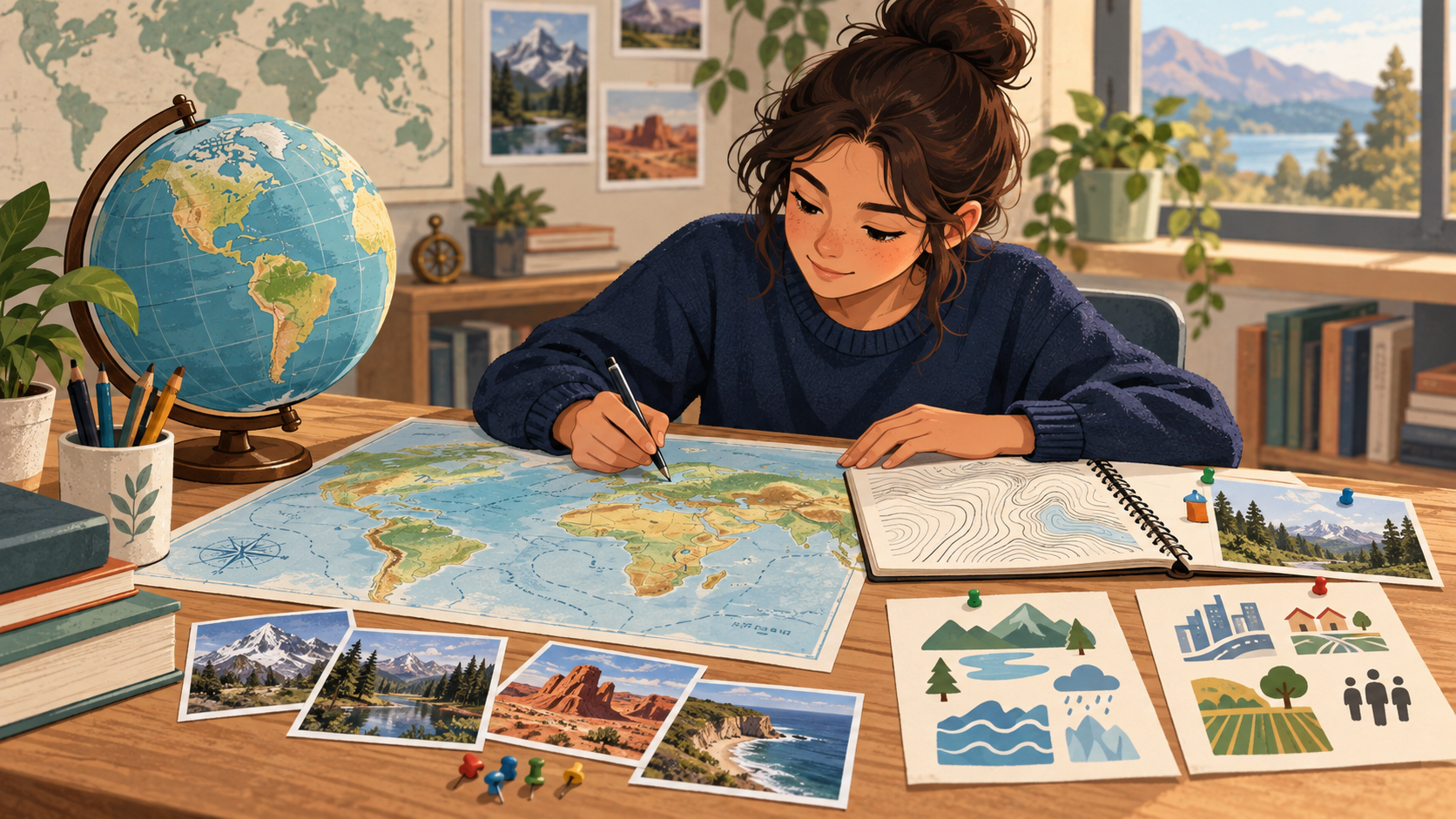
Learn how to study geography effectively with better map practice, simple case-study notes, command-word practice, and a realistic revision plan.
Geography is not only a subject about learning names on a map. You may need to explain why a place changes, compare two locations, interpret a graph, use evidence, and judge whether a plan would work. That mix makes geography interesting, but it can also make revision feel scattered.
The easiest way to study geography effectively is to connect facts to a clear story. Learn where something happens, why it happens, what the effects are, how people respond, and what the evidence shows. This guide gives you a simple method for maps, physical geography, human geography, case studies, and exam questions.
Why geography is more than memorising places
Facts matter in geography, but facts are most useful when you know how they fit together. A river flood is not just a definition. It has causes, impacts, responses, and different effects on different groups of people. A city is not just a location. It has patterns of growth, challenges, decisions, and trade-offs.
When you revise, ask four questions: where is it, why is it there, what happens because of it, and what could be done? These questions turn a list of notes into an explanation. They also match the way many exam questions are written.
Build a clear topic map
Start each unit with a one-page topic map. Put the main theme in the centre, then add branches for key terms, processes, examples, data, diagrams, and exam questions. Use a different colour for physical ideas and human ideas if that helps you see the difference.
Check the map against your syllabus or class checklist. Mark each branch as confident, partly known, or needs practice. Work on one small branch at a time. A plan such as “learn rivers” is too vague. “Explain how a meander changes and complete two six-mark questions” gives you a task you can actually finish.
Learn maps and diagrams actively
Maps are easier to remember when you draw them yourself. Look at a map for a short time, close it, and sketch the main shape or features from memory. It does not need to be artistic. Add only the information that helps you answer questions: a coastline, a river, a city, a mountain range, or a risk zone.
Practise diagrams in the same way. For a process such as a waterfall, draw the stages and add one sentence explaining each stage. Then cover the labels and test yourself. Linking a picture with a short explanation gives your memory more than copying a finished diagram.
Turn case studies into short stories
Case studies often feel difficult because notes contain too many numbers and names. Turn each one into a short story with five parts: place, problem, causes, effects, and responses. Add two or three strong facts, not every fact you have ever collected.
For example, a case study about a city may include its location, population change, one challenge, one piece of evidence, and one response. Practise saying the story in thirty seconds. Then practise expanding it into a paragraph. This helps you use the case study instead of simply recognising it in your notebook.
Use cause, effect, and evaluation
Many geography answers become stronger when they show a chain. Start with a cause, explain the immediate effect, then continue to a wider effect. Use linking words such as because, therefore, which means, and as a result. Finish by showing who is affected or why the impact matters.
Evaluation means making a judgement with a reason. You might decide that one response is more effective because it protects more people, costs less, lasts longer, or is more sustainable. Do not add “overall” at the end without explaining why your judgement follows from the evidence.
Practise geography exam command words
Command words tell you what the examiner wants. Describe usually asks for what you can see. Explain asks for reasons or links. Compare asks for similarities and differences. Assess or evaluate asks for a balanced judgement. Study these words and practise writing one answer for each.
Before you begin an answer, underline the command word and the topic. For a data question, also note the unit and time period. This small pause prevents you from writing a memorised paragraph that does not answer the question.
Revise physical geography
Physical geography includes processes that can be shown as sequences. Use flow diagrams for erosion, weather systems, tectonic hazards, ecosystems, and water cycles. Keep each arrow meaningful. If you cannot explain why one step leads to the next, return to the earlier idea.
Mix recall with application. After learning a process, apply it to a new diagram or an unfamiliar place. Exams often change the picture or wording. Understanding the process means you can still answer when the example looks different.
Revise human geography
Human geography often involves change, choices, and different viewpoints. Use comparison tables for rich and poor areas, rural and urban places, or different development strategies. Add who gains, who loses, and what the limits are.
When studying a policy or project, do not only list advantages. Ask whether it is affordable, fair, practical, and sustainable. This gives you material for longer answers and helps you make a clear judgement instead of giving a one-sided list.
Use data and evidence in answers
Graphs and figures are not decoration. Practise reading the trend, quoting a useful figure, and explaining what it shows. A strong data sentence usually has a pattern and evidence: the value rises, falls, stays similar, or changes at a particular point.
Do not invent precision. If the graph gives an approximate value, use words such as about or roughly. If the question asks you to use the resource, refer to it directly. Then add your geography knowledge to explain the pattern.
Plan geography revision across the week
A balanced week might include one physical process, one case study, one map or data task, and one exam answer. Short sessions make it easier to return to a topic before you forget it. A study planner can help you spread topics instead of leaving every case study for the weekend before the exam.
End each session with a quick retrieval check. Close your notes and write five facts, draw one diagram, or answer one question. Track the topics that still feel weak so the next session has a clear purpose.
Common geography study mistakes
One mistake is writing beautiful notes without testing recall. Another is learning case-study facts without learning the story around them. Some students also ignore diagrams and data because they prefer reading paragraphs. Exams can test all of these forms, so your revision should include all of them.
Avoid using the same answer for every question. A describe question needs a different response from an evaluate question. Also avoid adding random statistics that you cannot explain. A few accurate, relevant facts are stronger than a long list.
Frequently asked questions about studying geography
How do I remember geography case studies?
Use a five-part story: place, problem, causes, effects, and responses. Keep two or three strong facts for each case study and practise recalling the story without notes.
How can I improve geography exam answers?
Underline the command word, plan the chain of explanation, use evidence, and finish longer answers with a reasoned judgement. Mark your answer and rewrite one weak paragraph.
Should I draw maps from memory?
Yes. Draw simple maps from memory and check them afterwards. The goal is not artistic accuracy; it is remembering the features that help you explain a place or process.
How long should a geography revision session be?
Choose a length you can focus on, often twenty-five to forty-five minutes. Give each session one clear result, such as a completed diagram or a marked exam answer.
Related AcademyNC tools
Use the AcademyNC study planner to organise physical and human geography across the week. The AI practice quiz can test key terms and case-study recall, while the grade tracker and insights tools can help you notice which question types need more work.
Final thoughts
To study geography effectively, connect place, process, people, evidence, and judgement. Draw maps, tell case-study stories, practise command words, and use real exam questions early. Geography becomes much easier when every fact has a job in an explanation.




