
How to Study History Effectively: Dates, Causes, and Essay Questions
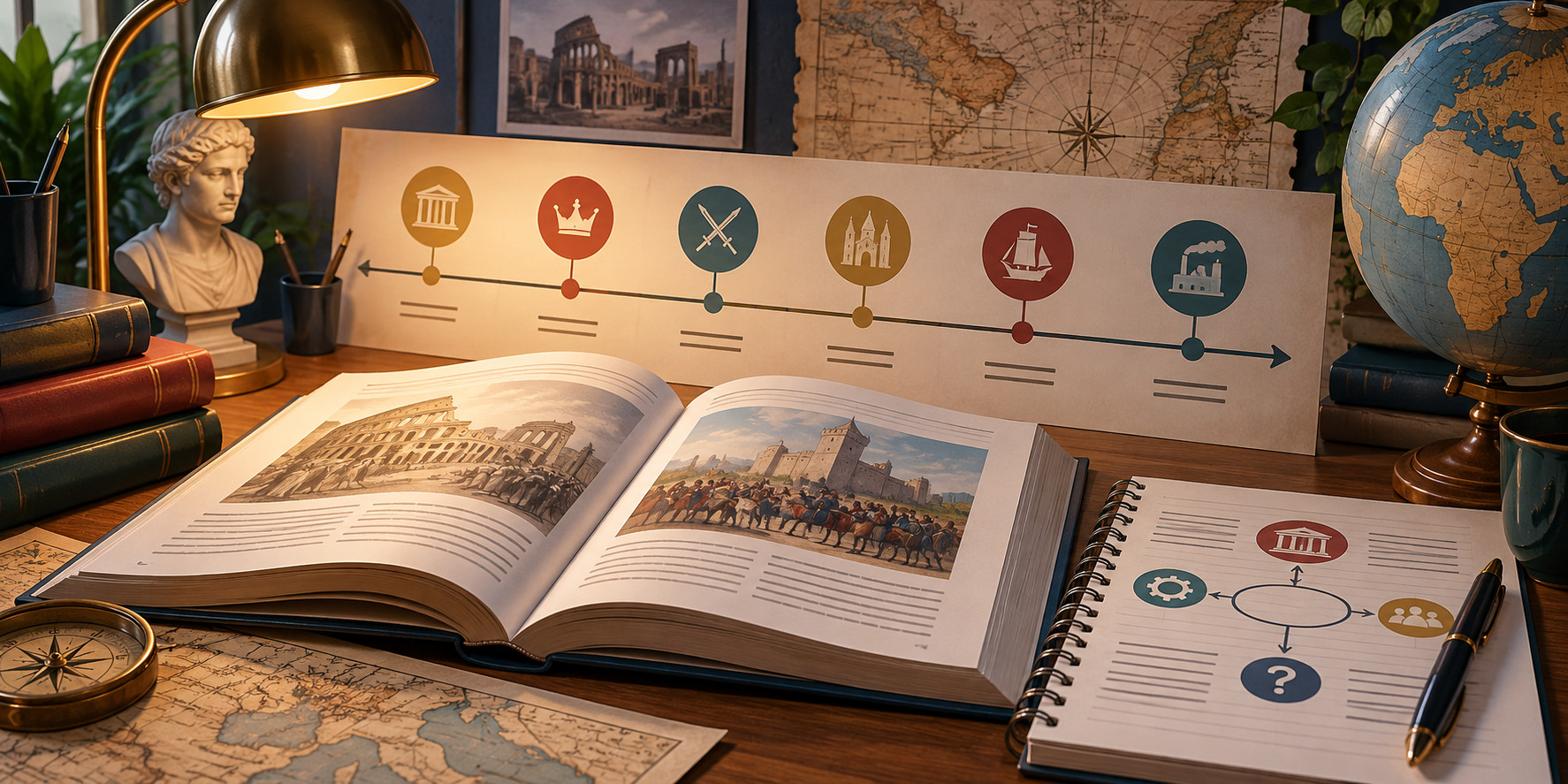
Learn how to study history by building the story first, connecting causes and consequences, remembering key dates, and practising strong essay answers.
History can feel like a huge list of dates, names, battles, laws, and places. That is why many students read the same chapter again and again but still struggle in a test. The problem is usually not effort. It is the way the information is organised in memory. History becomes easier when you understand the story, connect events, and practise the kind of answers your exam asks for.
This guide explains how to study history effectively for school or college exams. You will learn how to build a useful timeline, remember causes and consequences, revise evidence, practise source questions, and plan history essays. You do not need to memorise every sentence in your textbook. You need a clear structure that helps you find the right fact when you need it.
Why history is more than memorising dates
Dates matter, but a date on its own is not a strong answer. You also need to know what happened, why it happened, who was affected, and what changed afterwards. A date becomes easier to remember when it is attached to a short story and a clear reason.
For example, do not learn a year as an isolated number. Connect it to the event, the people involved, one important cause, and one consequence. When you can explain that small chain in your own words, the date has somewhere to live in your memory. This also helps with questions that ask you to explain importance rather than simply name an event.
Build the story before the timeline
Start each topic by writing a short summary in plain language. Imagine you are explaining the topic to a younger student who has never heard of it. What was the situation at the beginning? What problem grew? What decision or event changed the direction? What was different at the end?
This first story does not need every detail. It gives you a map. Once the map is clear, add the details that your course or exam expects. If you begin with a long list of names, your brain has no structure for placing them. If you begin with the story, each name and date has a role.
Build the story in five or six sentences, then close your notes and retell it. If you get stuck, look only at the part you forgot. This is more useful than reading the whole page again because it shows you exactly where the gap is.
Make a simple timeline
A timeline is useful when it shows relationships, not when it becomes a crowded wall of tiny writing. Choose the most important events first. Put the date, a short event label, and a few words about why the event matters. Leave space between major turning points so the timeline remains easy to scan.
Use different colours carefully. One colour could show causes, another could show decisions, and a third could show consequences. Keep the same system across a topic. You should be able to look at the timeline and see movement, not decoration.
Test yourself with a blank timeline. Write the main dates from memory, then add the event and its meaning. Check your answer afterwards. The blank version is the real practice; copying a finished timeline only proves that you can recognise it.
Connect causes, events, and consequences
For every major event, ask three questions: What caused it? What happened? What did it change? Write the answers as a chain. Some events have several causes, so group them into political, economic, social, religious, or personal causes when that helps.
Then rank the causes. Which cause made the event more likely? Which cause created the final trigger? Which cause was important in the long term? Ranking forces you to think like an examiner because history essays often reward judgement, not just a list.
Do the same with consequences. Separate short-term effects from long-term effects. Ask who benefited, who lost power, and what problem remained unsolved. These questions help you build explanations that are more detailed than “this led to that.”
Learn people and terms by their role
Names are easier to remember when you know what each person did. Create a small card or note for important people with four lines: role, goal, action, and result. You do not need a biography unless your course requires it. You need the part of the person’s life that connects to the question.
Do the same with key terms. Write the word, a simple definition, and one example from your topic. If a term is easy to confuse with another, put the two definitions side by side. Explaining the difference is stronger practice than reading both definitions separately.
Use active recall for history
Active recall means trying to produce an answer before looking at your notes. Ask yourself questions such as “What were the three main causes?”, “Why did this policy fail?”, or “How did this event affect ordinary people?” Write or say the answer, then check it.
Turn headings in your textbook into questions. Turn each timeline event into a cause-and-consequence question. Turn each key person into a role-and-impact question. If you want mixed practice, use the AI practice quiz to test facts, definitions, and explanations in one session.
Keep a list of questions you missed. Review that list more often than the questions you already know. Your weak answers are not proof that you are bad at history. They are a clear revision plan.
Practise source questions
Source questions often test more than whether you can understand the words. You may need to explain what a source says, how useful it is, why it was created, or how it compares with another source. Read the question first so you know what to look for.
For a usefulness question, consider the source’s content, origin, and purpose. What does it tell you? Who created it, and when? What might the creator want the audience to think or do? A source is not simply useful or useless. Its value depends on the question you are answering.
Practise with short extracts. Underline one piece of evidence, then explain it in your own words. Add one sentence about the source’s background. This builds the habit of connecting evidence to a judgement instead of copying a line and stopping.
Plan history essays before writing
Before writing a full essay, spend a few minutes planning. Read the command word carefully. “Explain,” “How far,” “Why,” and “How important” do not all require the same shape of answer. Circle the topic, the time period, and the exact judgement the question wants.
Write a one-sentence thesis that answers the question directly. Then choose three main points. For each point, add a specific fact and explain how it supports your argument. If the question asks for judgement, include a counterpoint and explain why your main view is stronger.
A simple paragraph pattern is point, evidence, explanation, and link back to the question. Do not let the evidence take over the paragraph. The fact is there to support your reasoning. After writing one plan, close your notes and try to rebuild it from memory.
Use evidence without dumping facts
Strong history answers use precise evidence, but they do not throw every remembered fact onto the page. Choose details that prove your point. A date, law, statistic, speech, or event is useful when you explain what it shows.
After each piece of evidence, ask “So what?” What does this detail tell the reader about the cause, the importance, or the change? If you cannot answer that question, the evidence may not belong in that paragraph.
Practise writing one paragraph in ten minutes. Then highlight your evidence in one colour and your explanation in another. If the page has lots of facts but very little explanation, rewrite the paragraph with fewer facts and clearer reasoning.
Review mistakes and weak topics
Keep an error log for history. Write the question, your first answer, the missing knowledge, and the better answer. Add a short note about the mistake. Did you forget a date? Mix up two people? Ignore the wording of the question? Give evidence without explaining it?
Review the error log every few days. Do not simply read the correct answer. Cover it and try again. Over time, the same mistakes will appear less often because you are practising the exact skill that caused the problem.
Create a weekly history study routine
A useful week can include different types of practice. On one day, build or improve the story and timeline. On another, test key terms and causes. Later, practise a source question or essay plan. Finish the week with a short mixed quiz.
Use a study planner to spread topics across the week instead of leaving one long session for the night before the test. A study timer can help you work in focused blocks, and a study time tracker can show whether you are spending too much time making notes and not enough time answering questions.
Keep sessions short enough to stay active. Twenty minutes of recall and one good essay plan can be more valuable than an hour of passive reading.
Frequently asked questions about studying history
How can I remember history dates faster?
Learn the story and the cause-and-effect chain first. Then attach a small number of important dates to the turning points. Use blank timelines and quick recall instead of copying dates repeatedly.
How many facts should I learn for each history topic?
Learn the facts that support the main causes, events, consequences, and arguments in your course. A smaller set of flexible evidence is more useful than a giant list you cannot explain.
How do I improve history essay marks?
Answer the exact question, make your judgement clear, use specific evidence, and explain why each detail supports your point. Practise plans and single paragraphs before writing full essays.
Related AcademyNC tools
Use the AI practice quiz to test names, dates, causes, and consequences. Use the study planner to spread history topics across several days. Start a study timer for a focused recall block, then use the study time tracker to see which topics still need attention.
Final thoughts
The best way to study history is to build meaning before memorising detail. Start with the story, make a simple timeline, connect causes and consequences, and practise the answer styles used in your exam. When you test yourself regularly, dates stop feeling like random numbers and become part of a story you can explain.
You do not need perfect notes to make progress. You need clear questions, useful evidence, and honest practice with the parts that still feel difficult.




