
How to Use Mark Schemes to Improve Exam Answers
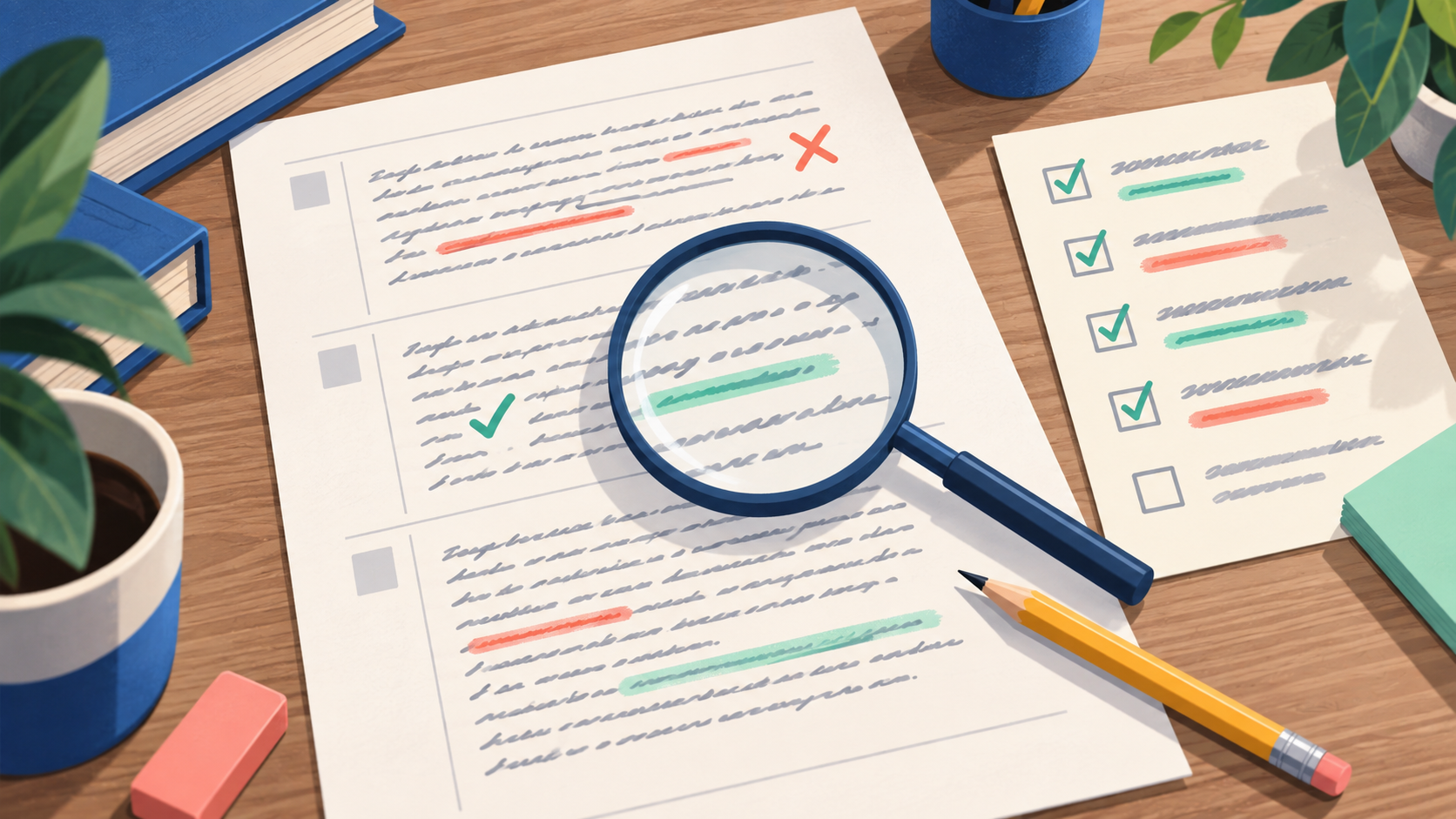
Learn how to use mark schemes after practice questions, spot missing knowledge and technique, rewrite weak answers, and stop repeating the same mistakes.
A mark scheme is more than a list of correct answers. It is a guide to the details and skills that earn marks. When you use it properly, you can see why an answer scored well, what was missing from your own response, and what to practise next. When you use it badly, you may simply copy phrases without understanding the topic.
This guide explains how to use mark schemes to improve exam answers. The method works with past papers, class tests, homework questions, and mock exams. The key is to attempt the question first, compare your answer carefully, and turn every useful correction into another practice opportunity.
Why mark schemes are useful
Students often mark a paper by ticking answers they got right and adding up the score. That gives a result, but it does not explain how to improve. A mark scheme can show whether you lost a mark because you forgot knowledge, missed a question word, gave too little explanation, or failed to use the source or case study.
It can also show the difference between a basic answer and a developed answer. In longer questions, the scheme may reward linked reasoning, accurate application, balance, or a supported judgement. Reading these details helps you understand what the examiner is looking for.
Read the question before the scheme
Always attempt the question without opening the mark scheme first. Read the command word, the topic, the number of marks, and any source, data, or scenario. Make a short plan if the question is longer. This gives you a fair picture of what you can do without help.
If you read the answer first, you may recognise it when you practise but still struggle to produce it in an exam. Honest attempts create better feedback. Even an incomplete answer is useful because it shows where your thinking stopped.
Should I read the mark scheme before answering?
Use the mark scheme before answering only when you are learning how a new question type works or studying a worked example. For a real practice test, answer first. You want to measure recall and technique, not recognition.
After marking, you can study the scheme closely and then try a similar question without looking at it. This gives you both explanation and independent practice.
Separate knowledge from technique
Ask two different questions about every lost mark. First, did I know the information? Second, did I show it in the way the question required? You may know a fact but lose the mark because you did not explain it, use the named example, compare both sides, or include the unit.
If you did not know the fact, revise the content. If you knew it but used it poorly, practise the question skill. Treating every error as a memory problem can make revision longer without fixing the real issue.
Find the exact point you missed
Do not write only “wrong” next to an answer. Find the smallest missing idea. It may be one key term, one link in a chain, a specific example, or a clearer judgement. Add that detail in a different colour so you can see what changed.
For a calculation, check the formula, substitution, arithmetic, unit, and rounding. For a source question, check whether you used the source and explained what it shows. For an essay paragraph, check whether the example actually proves the point.
Build an error category
Create a simple error log. Categories might include forgotten fact, unclear definition, missed command word, incomplete explanation, weak application, repeated point, calculation slip, careless reading, and poor timing. Add the question and the correction under the category.
After several papers, count the categories. If technique errors appear more often than knowledge gaps, shift your revision towards question practice. If one topic appears again and again, schedule it in your next study plan rather than hoping it will disappear.
Rewrite the answer after marking
Once you know what was missing, rewrite the answer in full or rewrite only the weak sentence. Use the mark scheme as a guide but explain the idea in words you understand. Then cover the scheme and read your new answer as if you were the examiner.
This second attempt matters. Reading a model answer can feel comfortable, but rewriting makes you retrieve the idea and organise it yourself. For a long answer, add the correction to the paragraph that needed it rather than copying the whole model response.
Learn accepted wording carefully
Some mark schemes use specific words because they describe the idea precisely. Learn those terms, but do not assume that every sentence must match the scheme exactly. Many schemes accept different wording when the meaning is correct.
Pay special attention to scientific terms, definitions, formulas, and labels. In subjects where wording is flexible, focus on accuracy and explanation. If you are unsure whether an alternative phrase is acceptable, ask your teacher or check an official examiner report.
Use examiner reports when available
An examiner report can explain common errors across many students. It may show why a popular answer was too general, why a source was not used effectively, or why a conclusion did not count as a judgement. Use it to understand the examiner’s view, not to memorise a paragraph.
Write one sentence from the report in your notes, then turn it into a personal rule. For example, “Every comparison must mention both items” or “Use the case-study detail, not only a general fact.” Keep the rule visible when you practise.
Turn corrections into new questions
Every correction can become a new flashcard or practice question. If you forgot a definition, ask for the definition tomorrow. If you missed a cause-and-effect link, write a “why does this lead to that?” question. If you forgot a case-study figure, ask yourself where and how the figure supports the point.
An AI practice quiz can help you create variations, but check that the questions match your syllabus. The purpose is to test the same idea in a new form so you know whether you understand it rather than remembering one correction.
Compare answers across practice papers
Do not study one paper in isolation. Keep examples of a weak answer, an improved answer, and a later answer to a similar question. Compare them for clarity, detail, application, and timing. You may notice that your knowledge improved but your structure did not, or that you now write faster but leave out explanations.
Look for repeated phrases that show improvement. A simple sentence such as “This means that…” can help develop a point. A clear comparison phrase can stop you writing two disconnected descriptions. Keep the techniques that genuinely help you earn marks.
What if my answer is different from the scheme?
Different wording is not automatically wrong. Mark schemes often list examples of acceptable answers rather than every possible sentence. Check whether your answer contains the required idea and whether it is accurate in context.
If your answer is sensible but not listed, ask your teacher to check it. Do not change a correct understanding just because the model uses different words. At the same time, do not use “different wording” as an excuse for a vague answer. Your meaning must be clear.
Avoid common mark scheme mistakes
Do not look at the scheme after every sentence while you practise. That interrupts your thinking and gives a false sense of progress. Do not copy the entire scheme into your notes. It is usually too long and may include alternatives that you do not need.
Avoid chasing the exact score without understanding why marks were awarded. A score is useful, but the correction is the real value. Also remember that some extended-response levels use a best-fit judgement, so one missing phrase does not always equal one lost mark.
Create a feedback routine
Set aside time to mark soon after you complete a paper. For each lost mark, write the error category and one correction. Rewrite the weak answer, then choose a follow-up question for later. This makes feedback an active part of revision instead of an unpleasant final step.
Use a study planner to schedule the follow-up questions. Use a study timer so marking does not take the entire session. Record repeated error types with the study time tracker or a simple notebook so you can see whether the same problem is reducing.
How do I stop making the same mistake?
Name the mistake in a way you can recognise. “Bad at history” is too broad, but “I give a fact without explaining its effect” is useful. Write a short rule, practise two similar questions, and check that rule before your next paper.
Return to the correction after a few days. If you only fix it on the day you made the mistake, the learning may be temporary. Retrieval over time helps you use the improvement when the question looks different.
Frequently asked questions about mark schemes
How often should I use mark schemes?
Use them after practice questions, but give yourself time to attempt the answer first. You do not need to complete a full paper every time. A small set of questions can give useful feedback when you study the corrections properly.
Can I revise only from mark schemes?
No. Mark schemes show what answers need, but they do not teach the full topic. Combine them with notes, lessons, textbooks, examples, and practice. Use the scheme to check and guide your work.
What if the mark scheme is hard to understand?
Ask a teacher to explain the command words or level descriptions. Rewrite the scheme in simple language and attach it to an example answer. The aim is to understand the skill, not to memorise official wording.
Related AcademyNC tools
Use an AI practice quiz to turn corrections into fresh questions. Plan review sessions in your study planner, work in focused blocks with the study timer, and track repeated errors alongside your practice with the study time tracker.
Final thoughts
A mark scheme becomes powerful when it changes what you do next. Attempt the question honestly, find the exact missing point, classify the mistake, rewrite the answer, and try a similar question later. That cycle builds exam skill much faster than simply checking a score.
Use simple personal rules and review them often. Over time, you will begin to notice what a strong answer needs before you even open the mark scheme.




