
How to Use Spaced Repetition for Exam Revision
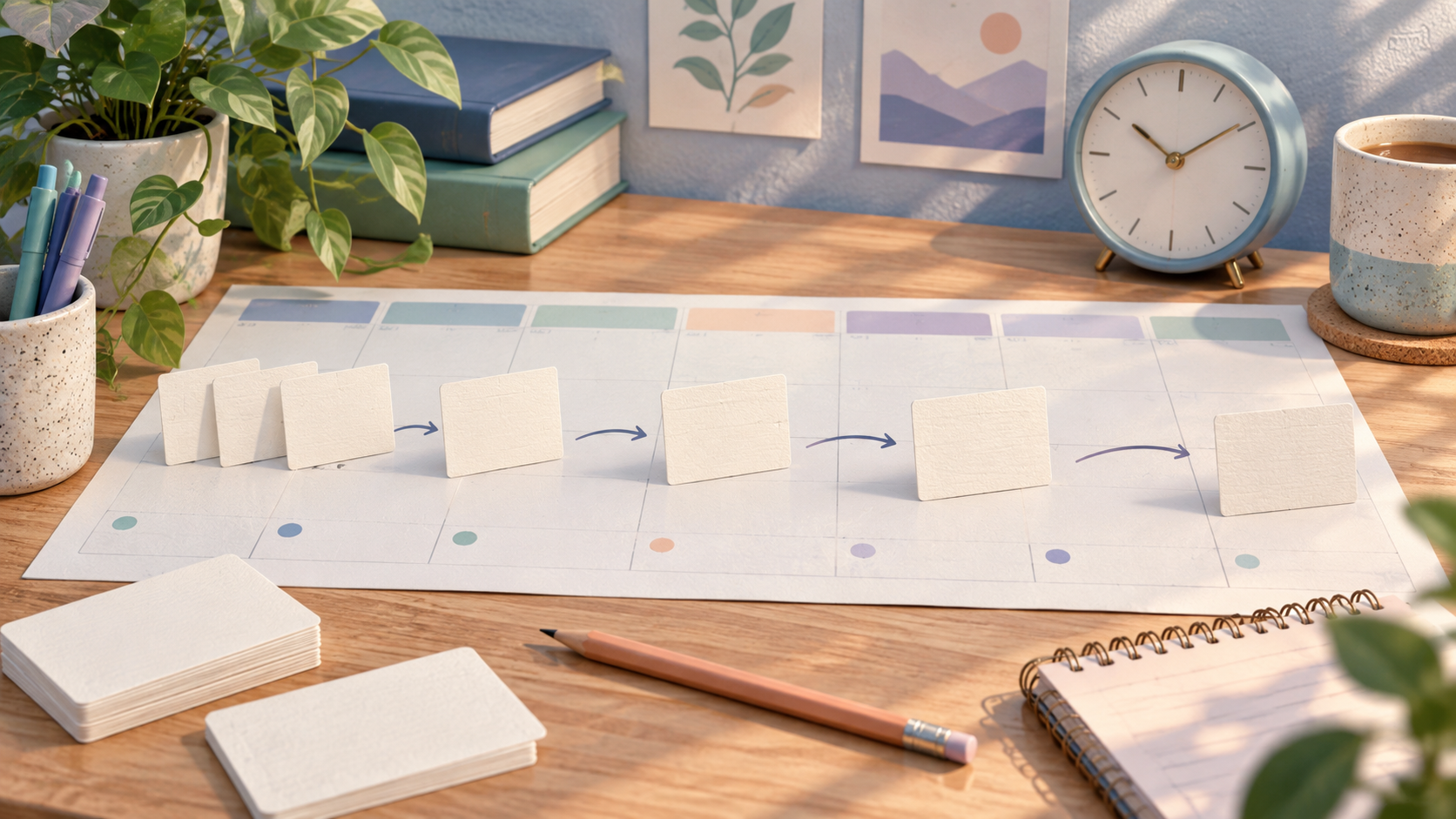
Learn how to use spaced repetition for exam revision with recall prompts, review gaps, mistake tracking, and a weekly plan that fits around school or college.
Spaced repetition is a simple way to return to learning over time instead of trying to study everything in one long session. You learn a topic, test yourself after a gap, and review it again later. The gaps grow when the information becomes easier to recall. This approach can make revision more regular and can show you what you are forgetting before the exam. It works best when the review involves active recall, not only looking at familiar notes. This guide explains how to use spaced repetition for exam revision in a realistic way.
Why spaced repetition works better than cramming
Cramming can make information feel fresh for a short time, but the memory may fade quickly after the session. When you return after a gap, you have to bring the idea back instead of simply recognising it on the page.
That effort is useful feedback. If you can recall the answer, you know it is becoming stronger. If you cannot, you know what needs another explanation or practice attempt. Spacing also stops one topic from taking over your whole week while other topics disappear.
You do not need a perfect app or complicated schedule. A notebook, calendar, spreadsheet, or study planner can be enough if you review consistently.
Start with a small content list
Begin with the topics required by your course. Do not put every sentence from a textbook into a review system. Choose definitions, formulas, processes, examples, dates, vocabulary, diagrams, and question structures that you genuinely need to remember.
Break large topics into small prompts. “Cell biology” is too broad for one card. “What is the role of the cell membrane?” is much easier to test. Small prompts make it clear whether you remembered the specific idea.
Mark the topics as new, learning, or secure. This helps you decide how often to review them and prevents the system from becoming a huge pile of identical cards.
Turn facts into recall prompts
Write questions rather than copying answers. A good prompt asks for one clear idea and can be answered without looking at the source. Include both directions when useful. Ask for a term from its meaning and for its meaning from the term.
Add context to a prompt when the fact could be confused. Instead of writing only a formula, ask what the formula measures and when it applies. Instead of writing a vocabulary translation, add a sentence pattern or example.
Keep answers short enough to check. For a long process or essay structure, split the prompt into stages or use a main question followed by smaller prompts.
Choose review gaps
Use shorter gaps at the beginning and longer gaps when recall becomes easy. You might review a new prompt the next day, again after a few days, then after a week and later in the month. Adjust the plan to the time before your exam.
A gap is not a punishment. If you forget an item, bring it closer again. If you recall it easily several times, let it move further away. The schedule should respond to your memory rather than follow a rigid rule that ignores your results.
Write the next review date beside each topic. A simple date makes the plan visible and prevents review from becoming a vague intention.
Use difficult cards more often
Separate prompts you miss from prompts you answer confidently. Difficult items need another explanation, a simpler example, or more practice. Do not keep repeating a card without asking why it is hard.
If you confuse two concepts, put them in a comparison prompt. If you forget a process step, draw it or explain the cause of each step. If you forget a formula, learn what each symbol means and practise choosing the method.
You can use a study timer for a short difficult-item session. Stop when the block ends and return later rather than turning one group of cards into an exhausting evening.
Mix spaced repetition with practice
Flashcards and recall prompts are useful for memory, but they do not replace exam questions. Once you know the basic idea, practise applying it. Use short answers, data questions, essays, calculations, diagrams, or speaking tasks that match your exam.
Add the missed question to your review system only when a prompt will help prevent the same error. Do not turn every full exam question into a giant card. Review the exact knowledge or decision that was missing.
A weekly mixed practice session shows whether your spaced recall transfers to the exam format. The answer should be available when the question is unfamiliar, not only when the prompt looks exactly like your card.
Avoid passive card habits
Reading the answer and thinking “I knew that” is not the same as recalling it. Hide the answer, speak or write your response, then check it. Mark uncertainty even when the final answer was close.
Avoid adding too many cards just to feel productive. A smaller set of well-written prompts is easier to review and more likely to be used. Delete or combine prompts that repeat the same idea.
Do not make every answer a paragraph copied from notes. Use short wording, examples, and follow-up questions. If an answer is long, break it into useful parts.
Fit reviews into a weekly plan
Place review blocks around classes, homework, work, and rest. A short daily review can be enough when the prompts are organised. Add longer sessions for practice questions and new topics.
Use a study planner to see which topics are due. A study time tracker can show whether your plan is realistic. If the review list grows every day, reduce the number of new prompts and repair the schedule.
Keep one catch-up block each week. Missing one day should not break the system. Move the most important items first and continue with the next review instead of trying to do everything at once.
Use an exam countdown
The time before the exam should affect your choices. Early in the course, you can introduce new material and use longer gaps. Closer to the exam, review high-value weak topics more often and add timed question practice.
In the final week, do not create an enormous new deck. Review key definitions, formulas, structures, and mistakes. Use past questions to check that recall is working under pressure.
After the exam, archive the old prompts or label them by subject. A clean system is easier to reuse for the next unit.
Track progress honestly
Record whether you produced the answer, needed a hint, or guessed. Honest tracking makes the next review useful. A correct answer that took a long time or needed a partial clue may still need a shorter gap.
Look for trends. Are you improving in one subject but falling behind in another? Are you missing vocabulary, definitions, formulas, or application? Use the pattern to change your plan.
Do not measure success only by the number of cards reviewed. The real result is being able to explain, solve, or write without help.
Frequently asked questions about spaced repetition
What review schedule should I use?
Start with a short gap, then increase it when recall is strong. A simple pattern can be the next day, several days later, one week later, and then every week or two. Adjust the gaps when an item is forgotten or when the exam is close.
Is spaced repetition the same as using flashcards?
Flashcards are one tool for spaced repetition, but the method is the timing and active recall. You can use questions in a notebook, a calendar, a spreadsheet, or an app. Use the format that makes it easy to review and correct yourself.
What if I fall behind on reviews?
Do not try to complete every missed prompt in one sitting. Sort the list by exam importance and difficulty, review the highest priorities, reduce new items for a day or two, and restart the schedule. A flexible system is easier to maintain than an impossible one.
Related AcademyNC tools
A study planner can place review dates and practice sessions across the week. A study timer can protect short recall blocks. An AI practice quiz can turn a topic into prompts for retrieval. The study time tracker can show whether you are building a repeatable habit instead of relying on last-minute cramming.
Final thoughts
Spaced repetition is a practical rhythm: learn a small idea, recall it after a gap, review what you missed, and return again later. Turn notes into clear prompts, keep difficult items closer, and combine memory work with real exam questions. Do not chase a perfect schedule or fill a huge deck. A small system that you actually use will help more than a detailed plan that becomes impossible after one missed day.




