
Study Planner for Students: How to Build a Weekly Study Plan That Works
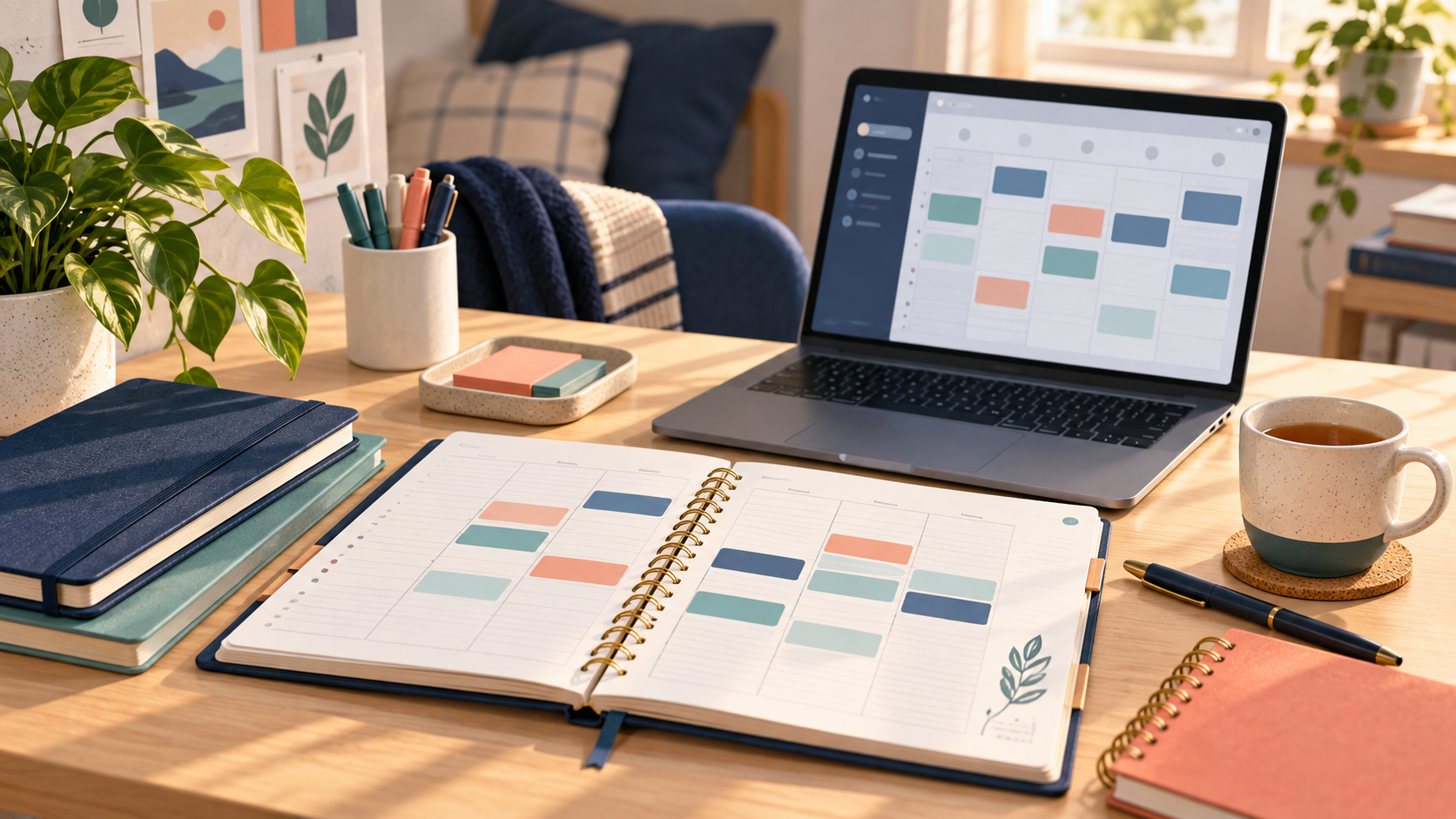
Learn how to build a realistic weekly study plan for students, organise homework and exams, use focus blocks, and stay on track without burnout.
A good study planner for students does more than fill a calendar. It helps you decide what to study, when to study it, and what “finished” actually means. That sounds simple, but many study plans fail because they are too full, too vague, or built around an ideal day that never happens.
A better plan is realistic. It leaves room for classes, travel, work, family, meals, sleep, and the occasional bad day. It also turns a large goal like “prepare for biology” into a small next step such as “review cell transport and answer 10 practice questions.”
In this guide, you will learn how to make a study plan for students, build a weekly study schedule, and use a free study planner without feeling trapped by it. The goal is not to control every minute. The goal is to make starting easier.
What Is a Study Planner?
A study planner is a place where you organise your subjects, assignments, exams, study sessions, and personal goals. It can be a paper notebook, a study planner template, a calendar, or an online study planner that combines tasks with time blocks.
A timetable usually shows fixed events such as classes or work shifts. A student study planner goes one step further. It helps you decide which chapter to read, which questions to practise, when to review your notes, and how much time to give each task.
The best planner is not the one with the most features. It is the one you can check quickly and use again tomorrow.
Why Do Study Plans Fail?
Before building a better study schedule, it helps to understand the common problems.
The plan is too ambitious. You schedule eight perfect hours after a full day of school, then feel like you failed when your energy runs out. A plan should challenge you, but it should still fit your real week.
The tasks are too vague. “Study chemistry” is not a clear task. It could mean reading, making notes, solving problems, or watching a lesson. When the task is unclear, starting feels harder.
There is no space for unfinished work. Homework can take longer than expected. A bus can be late. You may need to help at home. If every hour is already booked, one small delay can break the entire weekly study plan.
The plan tracks time but not learning. Ten hours of staring at notes is not the same as ten hours of active practice. A useful plan includes recall, questions, practice tests, and review.
How to Make a Study Plan That Works
1. Start with your fixed commitments
Write down classes, coaching, work, sports, family responsibilities, meals, and sleep. These are the parts of your week that are difficult to move. Add them first so your study timetable is built around real life.
Do not plan study blocks at a time when you are always travelling or exhausted. If you usually reach home at 5:30, give yourself time to eat and reset before starting. A plan that respects your routine is easier to follow.
2. Add deadlines and exam dates
Next, collect every important date in one place. Include tests, project submissions, homework deadlines, presentations, and application dates. If an exam is six weeks away, do not wait until the final week to begin.
Write the date beside each task. Then ask, “What must be ready before this date?” An essay may need a topic, outline, first draft, editing, and final submission. Each part deserves its own study block.
3. Break large subjects into small tasks
This is where a study plan for students becomes useful. Break each subject into actions that can be completed in one sitting.
Instead of writing “revise maths,” try:
- Review the formula sheet for quadratic equations
- Solve 12 mixed quadratic questions
- Mark the questions you got wrong
- Redo three difficult questions without looking at the answer
Small tasks give you a clear starting point. They also make progress visible, which helps when a subject feels too large.
4. Estimate time honestly
Give each task a rough time estimate. Start with 25 to 50 minutes for a normal focus block. A reading task may take 30 minutes, while a problem set may need 60 or 90 minutes.
If you are not sure, track the real time for one week. Your estimates will improve quickly. Remember to include setup and review time. “Read a chapter” may actually mean finding the chapter, reading it, writing short notes, and testing yourself.
5. Put difficult work at your best time
Notice when your mind works best. Some students focus well in the morning. Others become sharper after a short rest in the evening. Put your hardest subject in your strongest focus window when possible.
Use easier tasks for low-energy periods. You can organise notes, make flashcards, check homework instructions, or review mistakes when you do not have enough energy for a difficult chapter.
6. Add focus blocks and real breaks
A study schedule should include breaks. You can try a 25-minute focus block followed by a five-minute break, or a 50-minute block followed by a ten-minute break. Choose the rhythm that helps you return to the work.
During a break, stand up, drink water, stretch, or look away from the screen. Avoid turning a five-minute break into an hour of scrolling. If you want a simple way to start a session, use the AcademyNC study timer or Pomodoro timer.
7. Leave recovery space
Keep at least one small open block in your weekly study planner. This space is not wasted. It is where you move a task when life changes, or where you catch up before a deadline becomes stressful.
A good plan should help you recover, not punish you. If you miss a block, move the most important task to the next available slot and let the least important task wait.
A Simple Weekly Study Plan Example
Here is an example of a weekly study schedule for a student who has classes during the day and three subjects to prepare.
- Monday: Review maths notes for 30 minutes and solve 10 practice questions.
- Tuesday: Read one history section, make a short summary, and test yourself from memory.
- Wednesday: Complete the chemistry homework and mark any question that needs help.
- Thursday: Review maths mistakes and practise the two weakest question types.
- Friday: Take a lighter session. Organise notes and check all deadlines for next week.
- Saturday: Complete one longer exam-practice block, then review the mistakes while they are fresh.
- Sunday: Plan the next week, revise difficult topics, and keep one flexible catch-up block.
This example is not a rule. You can change the days, session lengths, and subjects. The important parts are clear tasks, repeated review, and enough space to adjust.
How to Build a Daily Study Plan You Can Follow
A weekly plan tells you where you are going. A daily study plan tells you what to do next.
At the beginning or end of each day, choose two or three important tasks. Put the most important task first, but do not fill the entire day. A useful daily plan might look like this:
- First block: Review yesterday’s biology notes and answer five recall questions.
- Second block: Finish the first half of the history assignment.
- Third block: Use the study timer for 25 minutes of maths practice.
Final check: Write down what is finished and move only the unfinished priority to tomorrow.
Try to describe each task with a verb: solve, explain, outline, recall, compare, draft, or check. This makes your plan more active and easier to begin.
How to Use an Online Study Planner
An online study planner is helpful when your tasks, deadlines, and completed sessions need to stay together. AcademyNC’s study planner can be used alongside the AcademyNC study time tracker so you can compare the time you planned with the time you actually completed.
Start by adding the subject and the next small task. Add the deadline if there is one, then reserve a realistic focus block. When the block begins, open the timer and work on only that task. Afterward, record what you finished and what still needs attention.
You can also use the AcademyNC study tools hub to move between planning, timing, and progress tracking. Keeping these steps connected reduces the number of decisions you need to make when you sit down to study.
Study Planner for Exam Preparation
An exam study planner should work backwards from the exam date. Begin with the topics you must know, then give extra time to the subjects or chapters you find difficult.
A simple four-stage plan looks like this:
- Stage one: Cover the material. Read lessons, attend classes, and create short notes.
- Stage two: Practise active recall. Close the book and explain the ideas in your own words.
- Stage three: Solve exam-style questions. Track the topics and question types that cause mistakes.
- Stage four: Review weak areas and complete timed practice. Do not spend the final days learning everything from the beginning.
If you are preparing for a specific exam, you can also use an exam-focused page such as the JEE study planner page, UPSC study planner page, or CAT study planner page. The same backward-planning idea works for school tests, college finals, and entrance exams.
Common Study Planner Mistakes to Avoid
Do not copy someone else’s routine without checking whether it fits your life. A plan made for a student with no job, commute, or family duties may not work for you.
Do not change the system every day. Give your study planner one or two weeks before deciding whether it helps. Make small adjustments instead of starting from zero.
Do not put every subject in every day. Repeated review is useful, but your brain also needs variety and rest. Rotate subjects across the week and give extra blocks to urgent or difficult work.
Do not hide unfinished tasks. Move them, reduce them, or ask for help. A planner is a decision tool, not a place to record guilt.
Do not plan without reviewing. At the end of the week, ask what worked, what took longer than expected, and which task should change next week.
Frequently Asked Questions
How many hours should a student study each day?
There is no perfect number for every student. Start with the time you can give consistently after classes, sleep, meals, and other responsibilities. Focused work matters more than sitting at a desk for a long time.
What is the difference between a study planner and a timetable?
A timetable shows recurring events and available time. A study planner also includes tasks, deadlines, priorities, revision, and completed work. Many students use both together.
Is a free study planner better than a paper planner?
Not automatically. A paper planner is great if you like writing by hand. A free study planner online can be easier to update, connect with timers, and review over time. Pick the format you will actually use.
What should I do if I fall behind my study plan?
Pause and choose the most important unfinished task. Move it to a realistic time, remove low-priority work, and keep the next block small. Falling behind is a reason to adjust the plan, not abandon it.
Can I use a study planner for homework?
Yes. A homework planner can hold due dates, reading, practice questions, projects, and revision. Add the first step instead of writing only the final deadline.
Final Thoughts
A study planner for students should make your week clearer, not make you feel watched by your own calendar. Start with fixed commitments, add deadlines, break subjects into small actions, and protect time for rest. Then use a timer and a progress check to learn what your plan really needs.
You do not need a perfect study timetable. You need a plan that helps you begin, gives you a clear next step, and can survive a busy week. Start with tomorrow’s first focus block, then improve the plan as you learn what works for you.